|
||||||||||
|
|
||||||||||
|
||||||||||
|
|
||||||||||
 - -
|
|
|
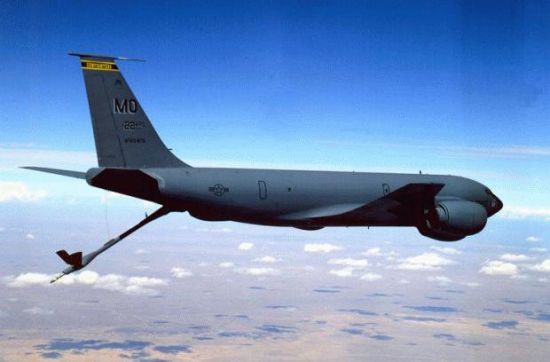
Boeing C-135 Stratolifter KC-135 Stratotanker Cargo Transport Refueling Tanker |
|
DESCRIPTION:
When Boeing began the 707 project in the early 1950s, the company gambled on the expensive and ambitious program hoping that the US military would also purchase the design as a jet-powered refueling tanker. The gamble paid off when, in 1954, the US Air Force announced its decision to purchase the 707 as a tanker and transport. The resulting Boeing 717, better known as the KC-135 and C-135, has become one of the most widely used and flexible aircraft in the Air Force inventory since its inception in the mid-1950s. While the principal transport variant, the C-135B, was soon replaced by the C-141 StarLifter, updated KC-135 Stratotankers, EC-135 command posts, and RC-135 reconnaissance platforms continue to serve in large numbers. Though based on the 707, the C-135 family differs in having a smaller diameter fuselage, no cabin windows, reduced weight, and lower passenger capacity. All tanker equipment, including an extendable refueling boom, is located on the lower deck in the KC-135 while the C-135 transport model provides room for up to 126 troops or cargo. Early models were powered by turbojets and progressive upgrade programs have seen these replaced by Pratt & Whitney TF33 turbofans and more recently CFM F108 turbofans with increased thrust and much lower fuel consumption. The principal model remaining in service is the KC-135R tanker whose updates allow it to do the job of three of the original KC-135As. Other notable applications of the C-135 include the EC-135B and EC-135N missile and spacecraft tracking models used to support the Apollo Moon missions as well as the RC-135S and RC-135X models used to track ballistic missiles. Also noteworthy are the EC-135C airborne command post as well as the RC-135U and RC-135V electronic surveillance variants used to collect signals intelligence on enemy air defense and communications systems. One of the most unique models is the OC-135B that flies over foreign nations photographing their military installations as part of the Open Skies Treaty.
Data below for KC-135R |
|
| HISTORY: | |
| First Flight |
(KC-135A) 31 August 1956 (C-135A) 19 May 1961 |
| Service Entry |
(KC-135A) 28 June 1957 (C-135A) 8 June 1961 (OC-135) June 1993 |
| Retirement |
(KC-135E) 23 September 2009
|
| CREW: |
(KC-135) four: pilot, co-pilot, 2 cargo crew (OC-135) seven: pilot, co-pilot, relief pilot, two navigators, mission commander, deputy mission commander, two sensor operators, two sensor maintenance technicians, flight follower (RC-135) 26: pilot, co-pilot, two navigators, three electronic warfare officers, 14 intelligence operators, four maintenance technicians |
| PASSENGERS: |
(KC-135) 80 (C-135) 126 troops, 44 stretchers |
|
ESTIMATED COST:
|
(KC-135A) $26.1 million (KC-135E) $30.6 million (KC-135R) $52.2 million |
| AIRFOIL SECTIONS: | |
| Wing Root | BAC 310/311/312 |
|
Wing Tip
|
BAC 313
|
| DIMENSIONS: | |
| Length | 136.25 ft (41.53 m) |
| Wingspan | 130.83 ft (39.88 m) |
| Height | 41.67 ft (12.70 m) |
| Wing Area | 2,433.0 ft² (226.03 m²) |
|
Canard Area
|
not applicable
|
| WEIGHTS: | |
| Empty |
(KC-135A) 98,465 lb (44,665 kg) (C-135B) 102,300 lb (46,405 kg) (KC-135R) 119,230 lb (54,080 kg) |
| Normal Takeoff | unknown |
| Max Takeoff |
(KC-135A) 297,000 lb (134,720 kg) (C-135B) 275,000 lb (124,740 kg) (KC-135R) 322,500 lb (146,285 kg) |
| Fuel Capacity | (KC-135R) 203,290 lb (92,210 kg) |
|
Max Payload
|
83,000 lb (37,650 kg)
|
| PROPULSION: | |
| Powerplant |
(KC-135A) four Pratt & Whitney J57-59W or J57-43WB turbojets (C-135B) four Pratt & Whitney TF33-3 turbofans (KC-135E) four Pratt & Whitney TF33-102 turbofans (KC-135R) four CFM International F108-CF-100 turbofans |
| Thrust |
(KC-135A) 55,000 lb (244.7 kN) (C-135B) 72,000 lb (320.3 kN) (KC-135E) 72,000 lb (320.3 kN) (KC-135R) 88,000 lb (391.4 kN) |
| PERFORMANCE: | |
| Max Level Speed |
at altitude: 610 mph (980 km/h) at 30,000 ft (9,150 m), Mach 0.93 at sea level: unknown cruise speed: 530 mph (850 km/h) at 30,000 ft (9,150 m) |
| Initial Climb Rate | (KC-135A) 1,290 ft (395 m) / min |
| Service Ceiling |
(KC-135A) 36,000 ft (10,980 m) (C-135B) 44,000 ft (13,425 m) (KC-135R) 50,000 ft (15,255 m) |
| Range |
typical: 1,305 nm (2,420 km) with 150,000 lb (68,040 kg) transfer fuel ferry: 9,590 nm (17,770 km) |
| g-Limits |
unknown
|
| ARMAMENT: | |
| Gun | none |
| Stations | none |
| Air-to-Air Missile | none |
| Air-to-Surface Missile | none |
| Bomb | none |
| Other |
none
|
| KNOWN VARIANTS: | |
| Model 367-80 | Original Boeing designation for the 707 and 717 program |
| Model 717 | Boeing designation for the military version of the 707, not to be confused with the current Boeing 717 (originally known as the McDonnell Douglas MD-95) which is a completely different aircraft |
| KC-135A Stratotanker | First production model for an Air Force in-flight refueling tanker; 732 built |
| C-135A Stratolifter | Long-range transport model; 15 built |
| EC-135A | KC-135A airframes converted to communications relay platforms and airborne command posts |
| JKC-135A | Test aircraft converted from KC-135A models |
| NC-135A | C-135A aircraft modified to monitor tests of nuclear weapons; 3 converted |
| NKC-135A | KC-135A aircraft fitted with a variety of additional systems and used for test purposes; 26 converted |
| RC-135A | KC-135A airframes modified with photo-reconnaissance and mapping equipment; 4 converted |
| VC-135A | VIP transport |
| C-135B | Similar to the C-135A model but built with turbofan engines and a larger tailplane; 30 built |
| EC-135B ARIA | Advanced Range Instrumentation Aircraft rebuilt from C-135B airframes and fitted with a large radar in a bulbous nose radome used to track missiles and spacecraft; at least 4 converted |
| KC-135B | In-flight refueling tanker equipped with command and communications equipment, later redesignated EC-135C; 17 built |
| OC-135B Open Skies | WC-135B airframes modified as observation aircraft and fitted with four cameras for taking photos over countries who are signatories to the Open Skies Treaty; 3 converted |
| RC-135B | Electronic reconnaissance model, never had any equipment installed or used operationally, but immediately converted to RC-135C models; 10 built |
| VC-135B | VIP transport rebuilt from C-135B models; 11 converted |
| WC-135B | Long-range weather reconnaissance model rebuilt from former C-135B airframes; 10 converted |
| C-135C | Former WC-135B aircraft converted back to transports |
| EC-135C | New designation for KC-135B airborne command centers |
| RC-135C | RC-135B aircraft modified with side-looking airborne radar (SLAR) pods, undernose radomes, and a camera bay; 10 converted |
| KC-135D | Former RC-135A aircraft modified as refueling tankers; 4 converted |
| RC-135D | KC-135A and C-135A airframes modified for use in re-entry vehicle photography; 7 converted |
| C-135E | C-135A airframes re-engined with Pratt & Whitney TF33 turbofans |
| KC-135E | KC-135A models re-engined with turbofan engines salvaged from former civil 707 aircraft; 161 converted |
| NKC-135E | Test aircraft fitted with TF33 turbofans; 1 converted |
| RC-135E | Former C-135B aircraft fitted with a large radome around the forward fuselage; 1 converted |
| C-135F or KC-135F | Transport and tanker model sold to France; 12 built |
| C-135FR | C-135F aircraft re-engined with CFM56 turbofans |
| EC-135G | KC-135A aircraft converted to a similar standard as the EC-135A but with a revised cabin arrangement, used as airborne command control centers for ballistic missile launch or communications relays; 4 converted |
| EC-135H | Airborne command posts rebuilt from KC-135A airframes plus a VC-135A and equipped with more advanced equipment; 5 converted |
| EC-135J | Rebuilt EC-135C airframes similar to the EC-135H but powered by turbofans and used as National Emergency Airborne Command Posts; 4 converted |
| EC-135K | KC-135A airframes modified with additional communications equipment for use in fighter deployment support; 2 converted |
| EC-135L | KC-135A airframes rebuilt as communications relays and command posts; 5 converted |
| RC-135M | Electronic reconnaissance model rebuilt from C-135B and VC-135B airframes and fitted with a thimble-nose radome, fuselage fairings, and a variety of antennae; at least 6 converted |
| EC-135N | C-135A models modified to carry a 7 ft (2.13 m) diameter parabolic dish antenna in the nose for the tracking of spacecraft; 8 converted |
| EC-135P | Airborne command post rebuilt from KC-135A, NKC-135A, and EC-135H airframes; 4 converted |
| KC-135Q | KC-135A aircraft modified to serve as tankers for the SR-71 Blackbird; 56 converted |
| KC-135R | Original designation for KC-135A airframes modified for special reconnaissance duties; 4 converted |
| KC-135R | Designation for extensively modernized KC-135A and KC-135E aircraft fitted with new CFM F108 turbobans, updated avionics, and a new APU; 371 converted |
| RC-135S Cobra Ball | Reconnaissance model fitted with large dipole aerials; 3 converted |
| TC-135S | RC-135S trainer with a reduced equipment fit; 1 converted |
| RC-135T | KC-135R airframe fitted with a thimble-nose radome and other avionics used for classified electronics surveillance; 1 converted |
| RC-135U Combat Sent | RC-135C aircraft fitted with specialized avionics, an undernose radome, fuselage fairings for a SLAR, and several antennae on the aft fuselage and tail; 3 converted |
| RC-135V Rivet Joint | RC-135C airframes and a RC-135U rebuilt with a thimble-nose radome, SLAR, and several underfuselage aerials; 8 converted |
| RC-135W | Former RC-135M models fitted with similar equipment as the RC-135V; 6 converted |
| TC-135W | RC-135V and RC-135W trainer with a reduced equipment fit; 1 converted |
| WC-135W Constant Phoenix | C-135B model modified as an atmospheric collection aircraft that takes air samples to support the Limited Nuclear Test Ban Treaty of 1963; 1 converted |
| RC-135X Cobra Eye | Model similar to the RC-135S and equipped for missile re-entry vehicle surveillance; 1 converted |
| EC-135Y |
Airborne command post
|
|
KNOWN COMBAT RECORD:
|
Vietnam War (USAF, 1965-1972) Libya - Operation El Dorado Canyon (USAF [KC-135], 1986) Iraq - Operation Desert Storm (USAF [KC-135], 1991) Bosnia - Operation Deliberate Force (USAF [KC-135, RC-135], France [C-135], 1995) Kosovo - Operation Allied Force (USAF, 1999) US Homeland Security - Operation Noble Eagle (USAF [KC-135], 2001-present) Afghanistan - Operation Enduring Freedom (USAF [RC-135], 2001-present) Iraq - Operation Iraqi Freedom (USAF [RC-135], 2003-present) Libya - Operation Unified Protector (France, Spain, USAF [KC-135, RC-135], 2011) |
|
KNOWN OPERATORS:
|
Australia (Royal Australian Air Force) Brazil, Força Aérea Brasileira (Brazilian Air Force) Canada (Canadian Armed Forces, Air Command) France, Armée de l'Air (French Air Force) Israel, Tsvah Haganah le Israel - Heyl Ha'Avir (Israeli Defence Force - Air Force) Italy, Aeronautica Militare Italiana (Italian Air Force) Morocco, Al Quwwat al Jawiyya al Malakiya Marakishiya (Royal Moroccan Air Force) Singapore (Republic of Singapore Air Force) South Africa, Suid-Afrikaanse Lugmag (South African Air Force) Spain, Ejército del Aire Española (Spanish Air Force) Turkey, Türk Hava Kuvvetleri (Turkish Air Force) United States (US Air Force) Venezuela, Fuerza Aérea Venezolana (Venezuelan Air Force) |
|
3-VIEW SCHEMATIC:
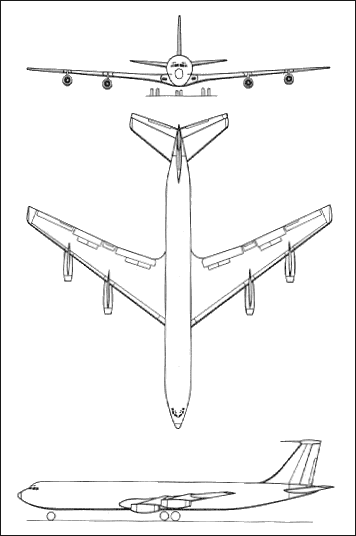
|
|
SOURCES:
|
|


|
Aircraft | Design | Ask Us | Shop | Search |

|
|
| About Us | Contact Us | Copyright © 1997- | |||
|
|
|||