|
||||||||||
|
|
||||||||||
|
||||||||||
|
|
||||||||||
 - -
|
|
|
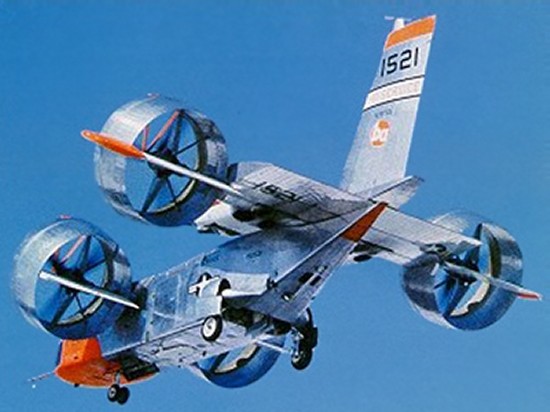
Bell X-22 V/STOL Research Aircraft |
|
DESCRIPTION:
One of the most unique attempts at vertical flight was embodied in the Bell X-22 that was sponsored by the US Navy during the 1960s. As part of the Tri-Service Program, the US Army, US Air Force, and US Navy each agreed to develop its own vertical/short takeoff and landing (V/STOL) concept under the joint supervision of all three services. The concept adopted by the Navy featured tilting ducted fans since these were considered more suitable for use aboard ships. The ducted fans, mounted in forward and aft pairs, were able to rotate through 90 degrees to transition from vertical to horizontal flight. Pilots were able to control the orientation and speed of the aircraft by varying the pitch of each propellor, to change thrust, and by deflecting elevator surfaces located in the wake of each engine duct. The power to drive each of these fans was provided by turboshaft engines mounted in pairs at the root of the stubby rear wing. The engines were also joined by cross-shafts so that each fan could still be powered in case one engine or more were to fail. Although the first X-22 managed to complete a series of vertical and short takeoff tests, a hydraulic failure on 8 August 1966 resulted in the total loss of the machine. All test duties were then transferred to the second example. This model was fitted with a variable stability system developed by the Cornell Aeronautical Laboratory (CAL) making possible great improvements in handling and general flight characteristics. Upon the completion of the Navy test program, the sole remaining X-22 was handed over on 19 May 1969 for use in a number of Tri-Service, FAA, and NASA V/STOL projects. In that time, the X-22 completed about 400 vertical takeoffs and landings, 200 short takeoff and landings, and 185 transitions between vertical and horizontal flight. In July of 1970, the aircraft was transferred to CAL to conduct further research flights, including the development of a HUD system for the AV-8B Harrier II V/STOL jet. The data collected during the X-22 program also provided vital information used in the design of the V-22 Osprey. The X-22 was retired in October 1984 after completing over 500 flights and is currently displayed at the Niagara Aerospace Museum.
Last modified 05 March 2011
|
|
| HISTORY: | |
| First Flight |
17 March 1966
|
| CREW: |
two: pilot, co-pilot
|
|
ESTIMATED COST:
|
unknown
|
| AIRFOIL SECTIONS: | |
| Wing Root | NACA 64A415 |
|
Wing Tip
|
NACA 64A415
|
| DIMENSIONS: | |
| Length | 39.58 ft (12.06 m) |
| Wingspan |
23.00 ft (7.01 m) across forward ducts 39.25 ft (11.96 m) across aft ducts |
| Height | 20.67 ft (6.30 m) |
| Wing Area | 425 ft² (39.56 m²) |
|
Canard Area
|
not applicable
|
| WEIGHTS: | |
| Empty | 11,460 lb (5,195 kg) |
| Normal Takeoff | unknown |
| Max Takeoff | 18,015 lb (8,170 kg) |
| Fuel Capacity |
internal: unknown external: unknown |
|
Max Payload
|
1,200 lb (545 kg)
|
| PROPULSION: | |
| Powerplant | four General Electric YT58-8D turboshafts |
| Thrust |
5,000 shp (3,728 kW)
|
| PERFORMANCE: | |
| Max Level Speed |
at altitude: unknown at sea level: 315 mph (510 km/h) cruise speed: 215 mph (345 km/h) at 11,000 ft (3,355 m) |
| Initial Climb Rate | unknown |
| Service Ceiling | 27,800 ft (8,475 m) |
| Range | 385 nm (715 km) |
| g-Limits |
unknown
|
| KNOWN VARIANTS: | |
| X-22A #1 | First example built, completed several STOL and V/STOL flights before a hydraulic failure led to a hard landing and loss of the aircraft after 15 flights totaling 3.1 flying hours |
| X-22A #2 | Second example, fitted with a variable stability system to vastly improve flight characteristics, completed 182 flights before being transferred to the Cornell Aeronautical Laboratory for another 300 some flights, retired in October 1984 and placed on display at the Niagara Aerospace Museum in New York |
| X-22A-1 | Proposal for an advanced armed ground support transport with a secondary cargo capability incorporating a redesigned forward fuselage containing tandem cockpit seating; not built |
| X-22B | Proposal for a follow-on X-22A carrying 1,400-shp T-58 turboshaft engines; not built |
| X-22C |
Proposal for an enlarged transport derivative with an aft cargo ramp and powered by 2,650-shp T55
turboshaft engines; not built
|
|
KNOWN OPERATORS:
|
United States (US Air Force) United States (US Army) United States (US Navy) United States (NASA) Cornell Aeronautical Laboratory |
|
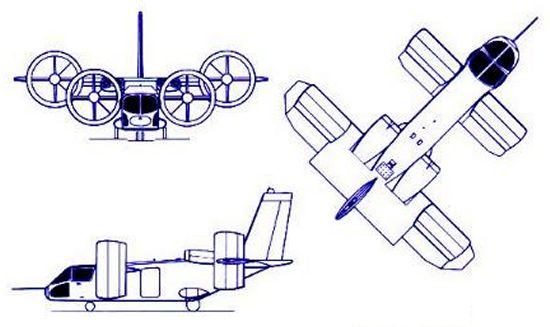
3-VIEW SCHEMATIC:
|
|
SOURCES:
|
|


|
Aircraft | Design | Ask Us | Shop | Search |

|
|
| About Us | Contact Us | Copyright © 1997- | |||
|
|
|||