|
||||||||||
|
|
||||||||||
|
||||||||||
|
|
||||||||||
 - -
|
|

|
Bell/ Boeing V-22 Osprey VTOL Transport |
|
DESCRIPTION:
The idea of uniting the vertical takeoff and landing capabilities of a helicopter with the high-speed cruise flight of an airplane has long intrigued aircraft designers. While many manufacturers have attempted to develop tiltrotors or "convertiplanes" with rotors at the wing tips able to pivot between "helicopter mode" and "airplane mode," the most successful company in this arena has been Bell. Bell first explored the tiltrotor concept in the 1950s, but the idea did not attract military attention until the flight of the XV-15 research aircraft of the 1970s. This design, the first in which the entire rotor nacelle was pivoted, proved so successful that the US Navy offered Bell and Boeing a contract to develop the concept into a transport aircraft for the Marine Corps. The resulting V-22 has a conventional cabin for two flight crew and up to 24 fully armed troops or cargo pallets. The two engine nacelles are located at each end of a slightly forward swept wing and are able to pivot through 97.5°. For greater safety, the engines are connected through a complex series of gearboxes so that one engine can power both nacelles in case the other engine fails. The V-22 also folds into a compact size for ship storage by folding the propeller blades inward and rotating the entire wing parallel to the fuselage. Due to its complexity and revolutionary design, the V-22 program has been plagued by technical difficulties, high cost, controversy, and the threat of cancellation. These issues were brought to a head in 2000 after two fatal accidents and revelations that Marine Corps officers had falsified maintenance records to improve the aircraft's readiness figures. These difficulties forced a two-year delay in the flight test program while the plane was grounded for modifications. After a nearly 20 year development period, however, the aircraft finally began entering service with the Marine Corps in 2007. The Marines originally planned to purchase 360 units of the MV-22 while the Navy wanted 48 aircraft for vertical replenishment and the Air Force was to buy 50 CV-22 models. However, the Department of Defense has directed the services to buy only 141 MV-22 variants for the Marines and 26 CV-22 models for Air Force special forces.
Last modified 22 March 2011
|
|
| HISTORY: | |
| First Flight | 19 March 1989 |
|
Service Entry
|
June 2007
|
| CREW: |
three: pilot, co-pilot, loadmaster
|
| PASSENGERS: |
24 troops
|
|
ESTIMATED COST:
|
$69.9 million [2006$]
|
| AIRFOIL SECTIONS: | |
| Wing Root | Bell A821201 (23%) |
| Wing Tip | Bell A821201 (23%) |
| Rotor Blade Root | XN28/XN18/XN12 |
|
Rotor Blade Tip
|
XN09
|
| DIMENSIONS: | |
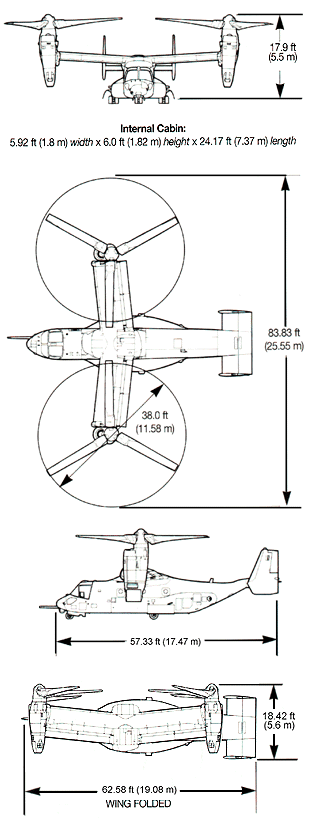
| Length | 57.33 ft (17.47 m) |
| Wingspan |
50.92 ft (15.52 m) including nacelles 84.50 ft (25.77 m) with rotors turning |
| Height | 21.75 ft (6.63 m) with nacelles vertical |
| Rotor Diameter | 38.00 ft (11.58 m) for each 3-bladed rotor |
| Wing Area | 382 ft² (35.49 m²) |
| Rotor Disk Area | 2,268 ft² (210.72 m²) total |
|
Canard Area
|
not applicable
|
| WEIGHTS: | |
| Empty | 33,140 lb (15,060 kg) |
| Normal Takeoff | 47,500 lb (21,545 kg) [vertical TO] |
| Max Takeoff |
52,870 lb (24,030 kg) [vertical TO] 57,000 lb (25,910 kg) [short TO, 20 deg tilt] 60,500 lb (27,500 kg) [short TO ferry] |
| Fuel Capacity |
internal: 13,850 lb (6,295 kg) external: unknown |
|
Max Payload
|
20,000 lb (9,090 kg) internally 15,000 lb (6,820 kg) externally 600 lb (272 kg) capacity rescue winch |
| PROPULSION: | |
| Powerplant | two Rolls-Royce/Allison AE1107C turboshafts |
| Thrust |
12,300 shp (9,172 kW)
|
| PERFORMANCE: | |
| Max Level Speed |
at altitude: 390 mph (630 km/h) [airplane mode] at sea level: 115 mph (185 km/h) [helicopter mode] |
| Initial Climb Rate | 2,320 ft (705 m) / min |
| Service Ceiling | 25,000 ft (7,630 m) |
|
Hover Ceiling (out of ground effect) |
7,000 ft (2,135 m) [HV-22] 5,000 ft (1,525 m) [CV-22] |
| Range |
typical: 505 nm (935 km) ferry: 2,100 nm (3,890 km) |
| g-Limits |
unknown
|
| ARMAMENT: | |
| Gun |
provision for two .50 caliber cabin guns a 7.62-mm remotely operated minigun providing 360° protection is in development |
| Stations | two external hardpoints |
| Air-to-Air Missile | none |
| Air-to-Surface Missile | none |
| Bomb | none |
| Other |
none
|
| KNOWN VARIANTS: | |
| MV-22 | Baseline assault transport for the US Marines, also equipped for medical evacutaion (up to 12 litters), search-and-rescue, supply transport, and special operations; 408 to be built |
| HV-22 | Search-and-rescue model for the US Navy, also equipped for special operations duties and fleet logistics; 48 originally planned but this model was cancelled as the Navy decided to purchase the standard MV-22 variant instead |
| CV-22 | Special operations model for the US Air Force, able to covertly insert and extract up to 18 troops while flying 500 nm (925 km) at 500 ft (150 m) or lower altitude; 50 to be built |
| PRV-22 |
Combat search-and-rescue model proposed to the US Air Force as a replacement for the
HH-60G Pavehawk; not developed
|
| KNOWN COMBAT RECORD: |
Iraq - Operation Iraqi Freedom (USMC, 2007) Libya - Operation Odyssey Dawn (USMC, 2011) |
| KNOWN OPERATORS: |
United States (US Air Force) United States (US Marine Corps) United States (US Navy) |
|
3-VIEW SCHEMATIC:
|
|
SOURCES:
|
|


|
Aircraft | Design | Ask Us | Shop | Search |

|
|
| About Us | Contact Us | Copyright © 1997- | |||
|
|
|||