|
||||||||||
|
|
||||||||||
|
||||||||||
|
|
||||||||||
 - -
|
|

|
McDonnell Douglas (now Boeing) C-17 Globemaster III Heavy Transport |
|
DESCRIPTION:
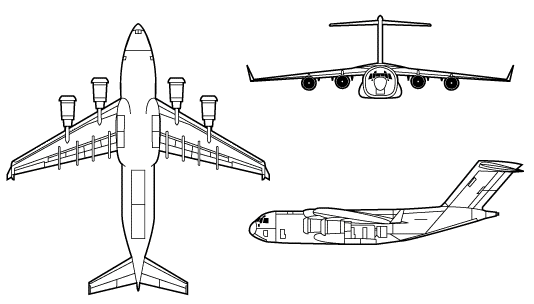
Following the Vietnam War, the US Air Force realized the inadequacies of its heavy-lift transport fleet and issued a requirement for a new design. While intended to supplement and eventually replace the C-141 StarLifter, this new C-17 transport would need to combine the heavy load-lifting capability of the C-5 Galaxy with the ability of the C-130 Hercules to land close behind the front lines on rough and unprepared fields. A McDonnell Douglas proposal meeting these requirements had been accepted by October 1980, but full scale development was cancelled in January 1982 when the USAF chose to purchase the improved C-5B Galaxy and KC-10 Extender instead. Later that year, however, the C-17 Globemaster III was reinstated as a high-priority program of which 210 examples were to be built. The McDonnell Douglas design largely follows traditional transport layout with a circular fuselage, high mounted wings, and a rear-loading cargo ramp. Prototypes were flying by the early 1990s, but costs began escalating rapidly. Despite production delays, high costs, and program mismanagement, the C-17 is a very capable design incorporating a number of advanced features. With a cargo cabin measuring 88 ft (26.82 m) by 18 ft (5.48 m) by 12.33 ft (3.76 m), the aircraft can accomodate up to 18 cargo pallets, 144 troops, 102 paratroops, or 48 litters. This capacity allows the C-17 to lift almost every piece of US Army mobile equipment including the M1 Abrams main battle tank, M2/M3 Bradley armored personnel carriers, up to four UH-60 Blackhawk transport helicopters, or up to two AH-64 Apache attack helicopters. In addition, the C-17 makes use of blown flaps, vortex generators, and thrust reversers for exceptional short field performance. The C-17 can operate from runways as short as 3,000 feet (915 meters) and as narrow as 90 feet (27.5 meters) and is maneuverable enough to reverse direction using a three-point turn. Although the Air Force originally hoped to procure 210 examples of the C-17, the subsequent development delays and cost overruns cut production plans to 120 aircraft. Nevertheless, the C-17 has proven so valuable during recent conflicts in the Balkans, Afghanistan, and Iraq that Congress has approved increasing the production run to 205 planes. Though Boeing has warned of closing the Globemaster production line multiple times, the Air Force continues to request additional aircraft every year hoping to keep assembly underway. The C-17 has also attracted several foreign customers including the UK, Australia, Canada, and Qatar. The multi-national defense orgainization NATO has also ordered three C-17 transports to share among the allies. Current production plans should keep the line open until at least 2010.
Last modified 06 April 2011
|
|
| HISTORY: | |
| First Flight | 15 September 1991 |
|
Service Entry
|
14 June 1993
|
| CREW: |
three: pilot, co-pilot, loadmaster
|
| PASSENGERS: |
144 troops, 102 paratroops, or 48 stretchers
|
|
ESTIMATED COST:
|
$205 million [1998$]
|
| AIRFOIL SECTIONS: | |
| Wing Root | unknown supercritical |
|
Wing Tip
|
unknown supercritical
|
| DIMENSIONS: | |
| Length | 174.00 ft (53.04 m) |
| Wingspan | 169.83 ft (51.76 m) |
| Height | 55.08 ft (16.79 m) |
| Wing Area | 3,800 ft² (353.02 m²) |
|
Canard Area
|
not applicable
|
| WEIGHTS: | |
| Empty | 277,000 lb (125,645 kg) |
| Normal Takeoff | unknown |
| Max Takeoff | 585,000 lb (265,350 kg) |
| Fuel Capacity | 181,055 lb (82,125 kg) |
|
Max Payload
|
169,000 lb (76,660 kg)
|
| PROPULSION: | |
| Powerplant | four Pratt & Whitney PW2040 (military designation F117-100) turbofans |
| Thrust |
161,760 lb (719.6 kN)
|
| PERFORMANCE: | |
| Max Level Speed |
cruise speed: 515 mph (830 km/h) at 28,000 ft (8,540 m), Mach 0.74 airdrop speed: 130 to 290 mph (215 to 465 km/h) at sea level |
| Initial Climb Rate | unknown |
| Service Ceiling | 45,000 ft (13,715 m) |
| Range |
typical: 2,400 nm (4,450 km) with 160,000 lb (72,575 kg) payload typical: 4,400 nm (8,155 km) with 40,000 lb (18,145 kg) payload ferry: 4,700 nm (8,710 km) |
| g-Limits |
unknown
|
| ARMAMENT: | |
| Gun | none |
| Stations | none |
| Air-to-Air Missile | none |
| Air-to-Surface Missile | none |
| Bomb | none |
| Other |
none
|
| KNOWN VARIANTS: | |
| C-17A | Production transport for the US Air Force able to airlift equipment, troops, paratroops, or casualties over global ranges while operating from rough strips; at least 190 to be built |
| CC-177 Globemaster | Designation for the C-17 in Canada |
| C-17B | Boeing proposal for a tactical version of the C-17 equipped with larger flaps and more powerful engines allowing operations from short airstrips close to the front lines |
| C-17FE | Proposal for an advanced tactical C-17 to meet a joint future theater lift requirement, would feature a narrower fuselage with composite components mated to the same basic wing and tail of the C-17A but modified with new flaps, blended winglets, higher-thrust engines, upgraded avionics for precision landings, and a tire inflation/deflation system for operations at different kinds of fields |
| KC-17 | Proposal for a tanker model using the center wing tank plus a modular tank pallet carried in the fuselage, fuel would be dispensed through a boom on the rear cargo door and/or underwing pods; not built |
| MD-17 | Proposal for a commercial heavylift model with roll-on/roll-off capability and able to carry 170,000 lb (77,110 kg) payloads over ranges of 5,000 nm (9,260 km) or more |
| BC-17 |
New designation for the MD-17 concept after McDonnell Douglas merged with Boeing
|
|
KNOWN COMBAT RECORD:
|
Bosnia - Operation Deliberate Force (USAF, 1995) Kosovo - Operation Allied Force (USAF, 1999) Afghanistan - Operation Enduring Freedom (USAF, 2001-present) Iraq - Operation Iraqi Freedom (USAF, 2003-present) Libya - Operation Unified Protector / Odyssey Dawn (Canada, Qatar, USAF, 2011) |
|
KNOWN OPERATORS:
|
Australia (Royal Australian Air Force) Canada (Canadian Armed Forces, Air Command) NATO Qatar (Qatar Emiri Air Force) United Kingdom (Royal Air Force) United States (US Air Force) |
|
3-VIEW SCHEMATIC:
|
|
SOURCES:
|
|


|
Aircraft | Design | Ask Us | Shop | Search |

|
|
| About Us | Contact Us | Copyright © 1997- | |||
|
|
|||