|
||||||||||
|
|
||||||||||
|
||||||||||
|
|
||||||||||
 - -
 - -
|
|
|
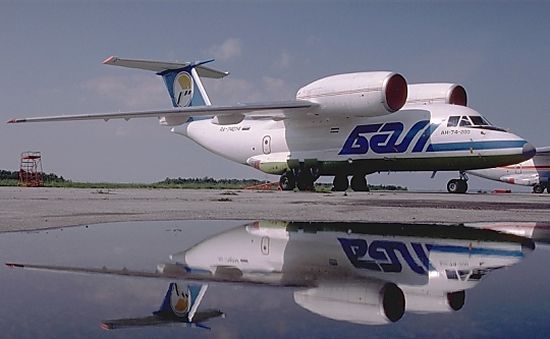
Antonov An-72, An-74 ASCC codename: Coaler Light Transport |
|
DESCRIPTION:
The An-72 first appeared in the late 1970s as a replacement for the An-26 transport. Since its introduction, the An-72 has come to fill a number of roles in the Russian military and also become a popular aircraft with several civil operators. Key to the An-72 design are its many advanced features intended to maximize short takeoff and landing (STOL) operations from rough fields. The plane's two turbofan engines, for example, are located above and forward of the high-mounted wing. In addition to minimizing foreign object damage to the engines, this placement allows the high-speed engine exhaust to be blown over the upper surface of the wing. The exhaust passes over double-slotted flaps placed on the inboard wing and is deflected downward by a phenomenon called the Coanda effect. Combined with triple-slotted flaps on the outboard wing, this aerodynamic design generates considerable lift to reduce runway distance. Other high-lift features, including full-span leading edge flaps, allow the An-72 to operate from very short fields. The An-72 also makes use of rugged landing gear with low-pressure tires that permit operations from unprepared fields, snow, or ice. To further improve arctic operations, Antonov developed the An-74 with ski-landing gear, de-icing equipment, and a number of other upgrades allowing the aircraft to support operations in Arctic or Antarctic environments. Another major variant of the design family is the An-72P maritime patrol model fitted with offensive weapons and various surveillance equipment. Military versions of the An-72 and An-74 continue to serve with the Russian Air Force while the An-74 is popular with Aeroflot and other airlines. At least 150 examples of the An-72 and An-74 were completed by 1994 and the type remains in production.
Data below for An-72A 'Coaler-C' |
|
| HISTORY: | |
| First Flight |
(An-72) 22 December 1977 (An-74TK-300) 20 April 2001 |
|
Service Entry
|
1980 (?)
|
| CREW: |
(An-72) three: pilot, co-pilot, flight engineer (An-74) five: pilot, co-pilot, flight engineer, radio operator, navigator |
| PASSENGERS: |
(An-72A) 68 troops, 57 paratroops, or 24 stretchers (An-72P) 40 troops or 22 paratroops (An-72S) 24 passengers, 38 troops, or eight stretchers |
|
ESTIMATED COST:
|
unknown
|
| AIRFOIL SECTIONS: | |
| Wing Root | unknown |
|
Wing Tip
|
unknown
|
| DIMENSIONS: | |
| Length | 92.09 ft (28.07 m) |
| Wingspan | 104.63 ft (31.89 m) |
| Height | 28.38 ft (8.65 m) |
| Wing Area | 1,062.0 ft² (98.62 m²) |
|
Canard Area
|
not applicable
|
| WEIGHTS: | |
| Empty | 41,995 lb (19,050 kg) |
| Normal Takeoff | 60,625 lb (27,500 kg) from 3,280 ft (1,000 m) runway |
| Max Takeoff |
(An-72A) 76,060 lb (34,500 kg) (An-74TK-300) 82,670 lb (37,500 kg) |
| Fuel Capacity | unknown |
|
Max Payload
|
22,045 lb (10,000 kg)
|
| PROPULSION: | |
| Powerplant | two Lotarev D-36 or D-436 turbofans |
| Thrust |
(D-36) 28,660 lb (127.5 kN) (D-436) 33,100 lb (147.2 kN) |
| PERFORMANCE: | |
| Max Level Speed |
at altitude: 440 mph (705 km/h) at 32,810 ft (10,000 m) at sea level: unknown |
| Initial Climb Rate | unknown |
| Service Ceiling | 38,715 ft (11,800 m) |
| Range |
typical: 430 nm (800 km) with maximum payload ferry: 2,590 nm (4,800 km) |
| g-Limits |
unknown
|
| ARMAMENT: | |
| Gun |
none (An-72P) one 23-mm GSh-23L cannon |
| Stations | (An-72P) three external hardpoints and an internal bomb hoise |
| Air-to-Air Missile | none |
| Air-to-Surface Missile | (An-72P) anti-ship missiles (?) |
| Bomb |
none (An-72P) various |
| Other |
none (An-72P) rocket pods, torpedoes, depth charges |
| KNOWN VARIANTS: | |
| An-72 'Coaler-A' | Prototypes and pre-production aircraft; 11 built including 1 static test article, 2 flying prototypes, and 8 pre-production airframes |
| An-72A 'Coaler-C' | Initial production STOL transport with a longer fuselage and increased wingspan |
| An-72AT 'Coaler-C' | Dedicated freight version of the An-72A compatible with international shipping containers |
| An-72S 'Coaler-C' | Executive transport fitted with a galley in a front cabin, work and rest areas in a central cabin, and 24 armchairs in a rear cabin, can also be reconfigured for transporting freight or 38 passengers or as an air ambulance carrying eight stretchers |
| An-72P | Maritime patrol variant equipped with weapons stations on either side of the fuselage and underneath the rear loading ramp, also equipped with sophisticated cameras and sensors to search for targets and pinpoint their positions, can be configured for up to 40 passengers or 22 paratroops |
| An-74 'Coaler-B' | Arctic/Antarctic support model with space for 5 crew, increased fuel capacity, larger radar in bulged nose radome, improved navigation equipment, better de-icing equipment, and can be fitted with wheels or skis |
| An-74A | Passenger or freghter model |
| An-74MP | Maritime patrol model that can carry up to 44 soldiers, 22 paratroops, 16 stretchers with medical staff, or 10 metric tons of cargo |
| An-74T | Dedicated freighter version equipped with an internal winch, roller equipment, and cargo mooring points, can also be fitted with static lines for paratroops or dropping air cargo |
| An-74T-100 | Variant of the An-74T fitted with a navigator station |
| An-74T-200 | Military transport based on the An-74T |
| An-74T-200A | Military transport |
| An-74TK | Convertible passenger/cargo model that can be equipped for up to 52 passengers, up to 10 metric tons of cargo, or a mix of the two |
| An-74TK-100 | Variant of the An-74TK configured for up to four flight crew including a navigator station |
| An-74TK-200 | Variant of the An-74TK configured for only two flight crew |
| An-74TK-300 | An-74TK model primarily for civil customers with more fuel efficient engines on conventional underwing pylons that gives up the STOL capabilities of earlier models in favor of lower operating cost and higher speed, also incorporates improved avionics and passenger comfort features |
| An-74-400 | Proposed stretch model of the An-74TK-300 with a fuselage insert to extend length by 26 ft (8 m), also would be equipped with uprated engines |
| An-74TK-100C | Air ambulance based on the An-74TK-100 able to carry two stetchers and four medical personnel plus six passengers in a VIP cabin or a total payload of 2 metric tons, can also be configured as a VIP transport for up to 22 passengers |
| An-74P-200 | Executive jet or VIP transport configured similarly to the An-72S for up to 12 passengers |
| An-74VIP | Executive transport configurable to customer request that can carry 10 or 16 passengers and oversized freight, such as an automobile, depending on the layout |
| An-71 'Madcap' |
Airborne early warning model with a large rotating radome housing a surveillance radar mounted atop a
swept-forward tailfin, the cabin contains stations for the radar operators; project cancelled after 3
prototypes built
|
|
KNOWN COMBAT RECORD:
|
none
|
| KNOWN OPERATORS: | |
| Civil |
Aeroflot Air Armenia Air One Antonov Airlines Atlantic Airlines Badr Airlines Bashkirian Airlines Darta Enimex Gazpromavia Intradco KS Avia Motor Sich Airlines RAF-Avia Yamal Airlines |
| Government/Military |
Angola, Força Aérea Nacional Angolana (National Air Force of Angola) Armenia (Armenian Air Force) Egypt, Al Quwwat al Jawwiya il Misriya (Egyptian Air Force) Georgia (Georgian Air Force) Iran (Islamic Republic of Iran Air Force) Kazakhstan (Kazakhstan Air Force) Libya, Al Quwwat al Jawwiya al Jamahiriya al Arabia al Libyya (Libyan Air Force) Moldova (Moldovan Air Force) Peru, Fuerza Aérea del Perú (Peruvian Air Force) Russia, Voyenno Vozdushniye Sili (Russian Air Force) Russia, Federal'naya sluzhba bezopasnosti Rossiyskoy Federatsii (Federal Security Service) Ukraine, Voyenno Vozdushnyye Sily (Ukraine Military Air Forces) Union of Soviet Socialist Republics, Voyenno Vozdushniye Sili (Soviet Air Force) United Nations |
|
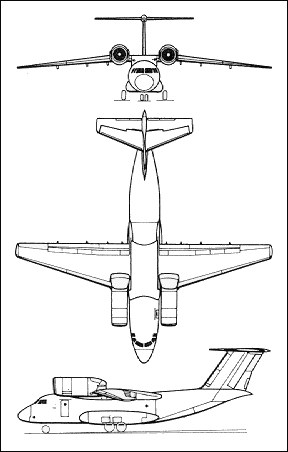
3-VIEW SCHEMATIC:
|
|
SOURCES:
|
|


|
Aircraft | Design | Ask Us | Shop | Search |

|
|
| About Us | Contact Us | Copyright © 1997- | |||
|
|
|||