|
||||||||||
|
|
||||||||||
|
||||||||||
|
|
||||||||||
 - -
 - -
|
|
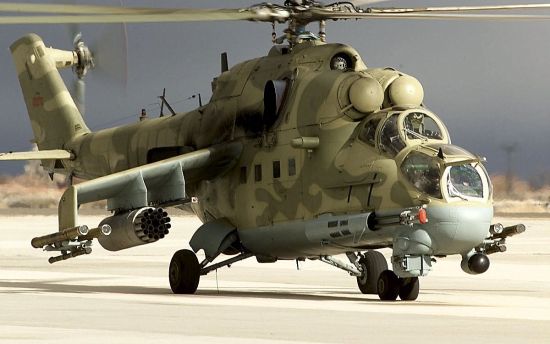
|
Mil Mi-24 ASCC codename: Hind Assault and Attack Helicopter |
|
DESCRIPTION:
Building on experience with the Mi-8 'Hip-C' transport and Mi-8 'Hip-E' gunship, the Mil design bureau attempted to develop a new helicopter merging the two traditionally separate roles. Such a helicopter would be able to airlift armed troops while having enough speed and armor to survive enemy fire plus sufficient armament to suppress ground defences. The subsequent Mi-24, known as the 'Hind' in the West, is a very versatile machine evolved from the Mi-8 but with a more slender fuselage, greater aerodynamic refinement, and more powerful engines. The Mi-24 features large wings that not only provide attachments for a variety of weaponry but also generate much of the lift in forward flight. The first operational variant, the Mi-24A 'Hind-A,' was a transitional design featuring a spacious cockpit for two pilots, a gunner, and an observer. The emphasis, however, remained on troop transport with an aft cabin providing room for up to eight troops or four litters. While this initial experience in the assault transport role proved successful, new views about the application of helicopters on the battlefield prompted development of a much improved gunship version. The Mi-24D 'Hind-D' variant, while still retaining a troop transport ability, was heavily redesigned for gunship and anti-armor missions. This Mi-24 version is easily distinguishable from earlier models by the completely revamped forward fuselage that abandoned the large single cockpit in favor of separate stepped tandem cockpits for the pilot (upper) and gunner (lower). In addition, the cockpit and rotor system are heavily armored for survival against ground fire, and new sensors were added for use with AT-2 anti-tank missiles. A more advanced variant, the Mi-24V 'Hind-E,' is armed with the far superior AT-6 missile, and the final Mi-24P 'Hind-F' model features a large 30-mm cannon. Though it is believed that neither the 'Hind-E' nor 'Hind-F' retains a troop transport capability, it is possible a support crew and missile reloads can be carried in the aft cabin for rapid rearming in the field. In total, over 2,500 Mi-24 helicopters and variants were built by the late 1990s. The type has seen considerable action, most notably during the Afghanistan War and more recent conflicts throughout Asia and Africa. The remaining Russian Mi-24 fleet is expected to be slowly retired and ulitmately replaced by the Ka-50/Ka-52 and/or the Mi-28.
Data below for Mi-24D and Mi-24V except where indicated |
|
| HISTORY: | |
| First Flight |
(V-24) 1968 (?) (Mi-24A) November 1970 |
| Service Entry |
(Mi-24A) 1973 (Mi-24D) 29 March 1976 (Mi-24V) 1980 |
| CREW: |
(Mi-24A) four: pilot, co-pilot, gunner/navigator, forward observer (Mi-24D/V/P) two: pilot, weapons officer |
| PASSENGERS: |
up to eight armed troops on early models possibly a support crew on later models |
| COST: | unknown |
| DIMENSIONS: | |
|
Maximum Length (rotors turning) |
70.04 ft (21.35 m) |
|
Fuselage Length (ignoring rotors) |
57.42 ft (17.50 m) |
| Rotor Diameter | 56.75 ft (17.30 m) |
| Wingspan | 21.46 ft (6.54 m) |
| Height |
13.00 ft (3.90 m) to top of rotor head 21.33 ft (6.50 m) rotors turning |
| MAIN ROTOR: | |
| Root Airfoil Section | NACA 23012 |
| Tip Airfoil Section | NACA 23012 |
| Rotor Area | 2,530.2 ft² (235.06 m²) |
| Number of Blades | 5 |
| Blade Chord | 1.92 ft (0.58 m) |
| Blade Area | unknown |
| Rotation Rate | 240 rpm |
| TAIL ROTOR: | |
| Diameter | 12.83 ft (3.91 m) |
| Rotor Area | unknown |
| Number of Blades | 3 |
| Blade Chord | unknown |
| Blade Area | unknown |
| Rotation Rate | unknown |
| WING: | |
| Area | unknown |
| Aspect Ratio | unknown |
| Incidence Angle | 19° |
| Anhedral Angle | 12° |
| UNDERCARRIAGE: | |
| Type | Retractable tricycle with two main gear and single steerable nose gear |
| Main Gear | Single wheel per unit, tire size 720 x 320 mm |
| Nose Gear | Twin wheels per unit, tire size 480 x 200 mm |
| Wheel Track | 9.92 ft (3.02 m) |
| Wheel Base | 14.42 ft (9.40 m) |
| WEIGHTS & LOADINGS: | |
| Empty |
(Mi-24A) 18,520 lb (8,400 kg) (Mi-24D) 18,080 lb (8,200 kg) (Mi-24V) 18,385 lb (8,340 kg) |
| Normal Takeoff | 24,250 lb (11,000 kg) |
| Maximum Takeoff | 26,455 lb (12,000 kg) |
| Internal Fuel Capacity |
3,790 lb (1,720 kg) in five fuselage tanks totalling 560 gal (2,130 L) plus 3,035 lb (1,375 kg) in two auxilliary tanks in the cabin totalling 450 gal (1,700 L) |
| External Fuel Capacity | 3,570 lb (1,620 kg) in four 130 gal (500 L) underwing tanks |
| Maximum Payload |
5,290 lb (2,400 kg) [external] or 1,765 to 3,305 lb (800 to 1,500 kg) [internal] |
| Disk Loading | unknown |
| Power/Weight Ratio | unknown |
| PROPULSION: | |
| Powerplant | two Klimov/Isotov TV3-117VM turboshafts |
| Engine Rating | 2 x 2,225 shp (1,660 kW) |
| Engine Intakes | Two side by side inlets with dust filters above the cabin |
| Fuel Type | unknown |
| PERFORMANCE: | |
|
Max Level Speed (at altitude) |
unknown |
|
Max Level Speed (at sea level) |
210 mph (335 km/h) |
| Cruise Speed | 185 mph (295 km/h) |
| Maximum Climb Rate | 2,460 ft (750 m) / min |
| Vertical Climb Rate | unknown |
| Service Ceiling | 14,765 ft (4,500 m) |
|
Hover Ceiling (in ground effect) |
7,210 ft (2,200 m) |
|
Hover Ceiling (out of ground effect) |
4,915 ft (1,500 m) |
| Range | 240 nm (450 km) |
| Ferry Range | 605 nm (1,125 km) |
| Duration | 2 hr 35 min |
| g-Limits | +1.8 |
| SYSTEMS: | |
| Avionics | SAU-V24-1 automatic control system with VAUP-1 autopilot and autohover system, DISS-15D Doppler navigation radar, Shtrum-V anti-tank weapon system with Raduga-SH aiming and missile control system, Falanga-P anti-tank system with Raduga-F unit, ASP-17 gun sight |
| Self-protection | SPO-10 Sirena or SPO-15 Beryoza radar warning receiver, L-166V-1A Lipa infrared countermeasures jammer, ASO-2 chaff/flare dispenser |
| Flight Controls | Mechanical |
| COMPOSITION: |
|
| ARMAMENT: | |
| Gun |
(Mi-24D) one 12.7-mm JakB-12.7 cannon (1,470 rds) (Mi-24P) one 30-mm GSh-30K cannon (750 rds) |
| Stations | two stub-wings with six hardpoints |
| Air-to-Air Missile | R-60/AA-8 Aphid, Srela, Igla |
| Air-to-Surface Missile |
(Mi-24D) up to four AT-2 Swatter or AT-3 anti-tank missiles (Mi-24V) up to twelve AT-6 Spiral anti-tank missiles |
| Bomb | up to four FAB-250, up to two FAB-500 |
| Other | up to four 20-round S-8 80-mm rocket pods, up to four 32-round S-5 57-mm rocket pods, GSh-23L 23-mm gun, 160-mm rockets, 210-mm rockets, 240-mm rockets, grenade launchers, KMGU submunition dispensers, ECM pods, chaff/flare dispensers |
| VARIANTS: | |
| V-24 | Prototype also called the Izdeliye 240 |
| A-10 | Designation for the Mi-24 prototype used to set world records |
| Mi-24 'Hind-B' | Pre-production test model with stub wings with no anhedral and no wingtip hartdpoints, the tail rotor on the starboard side, and no wingtip hardpoints |
| Mi-24A 'Hind-A' | First production model with the tail rotor moved to the port side and introducing the anhedral stub wings with wingtip hardpoints, used in the assualt role with room for three to four crew and eight armed troops, most no longer in service or upgraded to the Mi-24D/Mi-24V standards; 240 built |
| Mi-24U 'Hind-C' | Dedicated trainer similar to late production versions of the Mi-24A but lacking a gun turret and wingtip hardpoints |
| Mi-24B | Similar to the Mi-24A but with a JakB-12.7 machine gun in place of the earlier A-12.7 in the nose |
| Mi-24M | Originally a navalized model proposed as a ship-bourne multi-role helicopter; not developed |
| Mi-24BMT | Prototype minesweeper model; 1 built |
| Mi-24D 'Hind-D' | Dedicated assault gunship with a new forward fuselage featuring separate cockpits for the pilot and gunner, a new gun turret installation, bullet-proof windscreens, and improved armor, also equipped with titanium-reinforced rotor head and blades to withstand 20-mm ground fire, armed with up to four anti-tank missiles on two wingtip stations; approximately 350 built |
| Mi-24DU 'Hind-D' | Trainer model based on the Mi-24D but lacking the nose machine gun |
| Mi-24V 'Hind-E' | Improved gunship similar to the Mi-24D but with improved TV3-117V high-altitude engines, new sensor pods, and armed with AT-6 anti-tank missiles and AA-8 air-to-air missiles; approximately 1,000 built |
| Mi-24VP 'Hind-E' | Similar to the Mi-24V but with the four-barrel 12.7-mm machine gun replaced by a twin-barrel 23-mm cannon; 25 built |
| Mi-24N & Mi-24F | Experimental models based on the Mi-24V but testing new weapon and search/targeting systems |
| Mi-24P 'Hind-F' | Similar to the Mi-24V but with the 12.7-mm machine gun replaced by a large twin-barrel 30-mm cannon mounted on the starboard side of the fuselage; 620 built |
|
Mi-24R 'Hind-G1' or Mi-24RSh 'Hind-G1' |
Unarmed sampling and reconnaissance model equipped with mechanisms for taking air and water samples or marking areas contaminated by nuclear, biological, or chemical substances that first appeared following the Chernobyl nuclear power plant accident; 152 built |
| Mi-24RA 'Hind-G1' | New designation for the Mi-24R after modernization |
| Mi-24K 'Hind-G2' | Unarmed artillery spotting model similar to the Mi-24R but fitted with an AFA-100 camera in the cabin for photo reconnaissance as well as a computer-controlled electro-optical sight under the nose |
| Mi-24TS | Prototype for Russia's customs service modified from an Army Mi-24P; 1 converted |
| Mi-24PS | Police model used for patrol, rescue, and transport missions equipped with GPS, a weather radar or nose FLIR, secure communications gear, searchlights, and a loudspeaker; 1 converted from the Mi-24TS but later converted back to the Mi-24P configuration and replaced by a new prototype |
| Mi-24M | Proposed modernization program to reduce weight, upgrade the engines, add compatibility with newer weapons, improve night and adverse weather capabilities, improve maintenance, and increase service life |
| Mi-24MVM | Designation for Mi-24V airframes receiving the Mi-24M upgrades |
| Mi-24MPM | Designation for Mi-24P airframes receiving the Mi-24M upgrades |
| Mi-24 Sled | Environmental monitoring model for surveying water levels and oil spills |
| Mi-25 & Mi-25U | Export versions of the Mi-24D and Mi-24DU sold mainly to Third World countries |
| Mi-35 | Export version of the Mi-24V |
| Mi-35P | Export version of the Mi-24P |
| Mi-35M | Proposed modernization program for export models of the Mi-25/Mi-25/Mi-35 similar to the Mi-24M that includes upgrading the the Mi-24VP standard as well as integrating new weapons, avionics, uprated engines, and flight controls |
| Mi-35D | Modernization program offered to export customers to upgrade armament systems |
| Mi-35D1 | More advanced modernization program offered to export customers that replaces the rotors and wings, replaces the machine gun with a 30-mm cannon, adds a FLIR under the nose and reduces overall weight to improve flight performance |
| Mi-35D2 | Similar to the Mi-35D1 airframe modernization but with additional armament upgrades |
| COMBAT HISTORY: | |
|
|
Ogaden War (Ethiopia, 1977-1978) Cambodia (Vietnam, 1978) Chad (Libya, 1978-1987) Afghanistan War (Soviet Union, 1979-1989) Iran-Iraq War (Iraq, 1980-1988) Nicaragua (Sandinista forces, 1980-1988) Sri Lanka Tamil conflict (India, Sri Lanka, 1987-?) Iraq - Operation Desert Storm (Iraq, 1991) Sierra Leone civil war (Sierra Leone, 1991-2002) Croatia (Croatia, Yugoslavia, 1990-1995) Nagorno-Karabakh War (Armenia, Azerbaijan, 1992-1994) Chechnya (Russia, 1994-?) Sudan civil war (Sudan, 1995-present) Congo civil war (Congo, Zimbabwe, 1996-2003) Kosovo (Yugoslavia, 1998-1999) Macedonia conflict (Macedonia, 2001) Ivorian civil war (Côte d'Ivoire, 2002-2004) Iraq - Operation Iraqi Freedom (Poland, 2003-?) Congo (India UN peacekeepers, 2003-present) Afghanistan - Operation Enduring Freedom (Afghanistan, 200?-present) Somalia (Ethiopia, 2006-present) South Ossetia war (Georgia, Russia, 2008) Libya Civil War (Libya, Free Libya rebels, 2011) |
| OPERATORS: | |
|
|
Abkhazia (Abkhazian Air Force) Afghanistan (Afghan Air Force) Afghanistan (Afghan National Army Air Corps) Algeria, Al Quwwat al Jawwawiya al Jaza'eriya (Algerian Air Force) Angola, Força Aérea Popular de Angola (Angolan People's Air Force) Armenia (Armenian Air Force) Azerbaijan (Azerbaijan Air Force) Belarus, Voyenno Vozdushnyye Sily (Belarus Air Force) Bulgaria, Bulgarski Voenno Vozdushni Sili (Bulgarian Air Defense Force Military Aviation) Cambodia, Force Aérienne Royale Cambodge (Royal Cambodian Air Force) Chad, Force Aérienne Tchadienne (Chad Air Force) Croatia, Hrvatske Zracne Snage (Croatian Air Force) Cuba, Defensa Antiaerea y Fuerza Aérea Revolucionaria (Anti-Aircraft Defense and Revolutionary Air Force) Cyprus (Cyprus Air Force) Czechoslovakia, Ceskoslovenske Letectvo (Czechoslovak Air Force) Czech Republic, Cesk Letectvo a Protivzbusna Obrana (Czech Air Force and Air Defense) East Germany, Luftstreitkräfte/Luftverteidigung (Air Force/Air Defense Force) Eritrea (Eritrean Republic Air Force) Ethiopia, Ye Ityopya Ayer Hayl (Ethiopian Air Force) Equatorial Guinea (Equatorial Guinea Air Force) Georgia (Georgian Air Force) Germany, Deutsche Heeresfliegertruppe (German Army Air Corps) Hungary, Magyar Légierö (Hungarian Red Air Arm) Hungary, Magyar Honvedseg Repülö Csapatai (Hungarian Air Defense Group) India, Bharatiya Vayu Sena (Indian Air Force) Indonesia (Indonesian Army) Iran (Islamic Republic of Iran Air Force) Iraq, Al Quwwat Al Jawwiya al Iraqiya (Iraqi Air Force) Côte d'Ivoire, Force Aérienne de la Cote d'Ivoire (Ivory Coast Air Force) Kazakhstan (Kazakhstan Air Force) Kyrgyzstan (Kyrgyzstan Air Force) Libya, Al Quwwat al Jawwiya al Jamahiriya al Arabia al Libyya (Libyan Air Force) Libya (Free Libyan Air Force) Macedonia (Macedonian Air Force) Mongolia (Mongolian People's Army Air Force) Mozambique, Força Aérea de Moçambique (Mozambique Air Force) Namibia (Namibia Defense Force) Nicaragua, Fuerza Aérea - Ejército de Nicaragua (Nicaraguan Air Force) Nigeria (Nigerian Air Force) North Korea (Korean People's Army Air Force) Peru, Fuerza Aérea del Perú (Peruvian Air Force) Poland, Sily Powietrzne Rzeczypospolitej Polskiej (Polish Air Force) Poland, Polska Wojska Lotnicze i Obrony Powietrznej (Polish Air Defense and Aviation Force) Russia, Voyenno Vozdushniye Sili (Russian Air Force) Russia, Aviatsiya Voyenno-Morskoyo Flota Sily Rossii (Russian Naval Aviation) Rwanda, Force Aérienne Rwandaise (Rwandan Air Force) Serbia, Vazduhoplovstvo i PVO Vojske Srbije (Serbian Air Force) Sierra Leone (Republic of Sierra Leone Armed Forces Army Air Wing) Slovakia, Velitelstvo Vzdusnych Sil (Slovak Air Force) South Yemen (South Yemen Air Force) Sri Lanka (Sri Lankan National Air Force) Sudan, Silakh al Jawwiya As'Sudaniya (Sudanese Air Force) Syria, Al Quwwat al-Jawwiya al Arabiya as-Souriya (Syrian Air Force) Tajikistan (Tajikistan Air and Air Defense Troops) Turkmenistan, Voyenno-Vozdushneyye Sily (Turkmenistan Air Force) Uganda (Uganda People's Defence Force) Ukraine, Viys'kovo-Povitriani Syly Ukrayiny (Ukraine Military Air Forces) Union of Soviet Socialist Republics, Voyenno Vozdushniye Sili (Soviet Air Force) United States (US Army) Uzbekistan (Uzbek Air Force) Venezuela, Fuerza Aérea Venezolana (Venezuelan Air Force) Vietnam, Khong Quan Nhan Dan Viet Nam (Vietnam People's Army Air Force) Yemen, Al Quwwat al Jawwiya al Yemeniya (Unified Yemen Air Force) Zimbabwe (Air Force of Zimbabwe) |
|
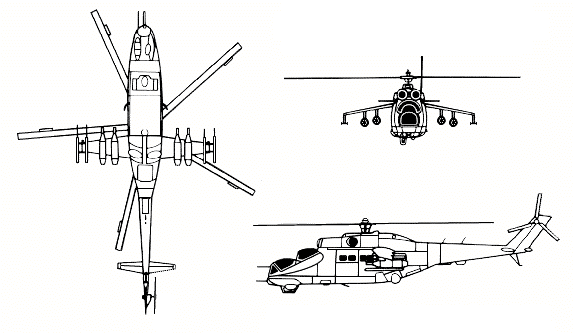
3-VIEW DIAGRAM:
|
|
SOURCES:
|
|
|
|
|


|
Aircraft | Design | Ask Us | Shop | Search |

|
|
| About Us | Contact Us | Copyright © 1997- | |||
|
|
|||