|
||||||||||
|
|
||||||||||
|
||||||||||
|
|
||||||||||
 - -
|
|
|
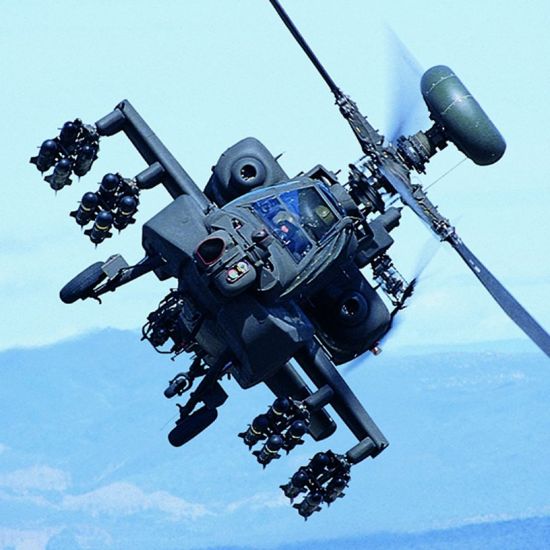
McDonnell Douglas (now Boeing) AH-64 Apache Attack Helicopter |
|
DESCRIPTION:
Following the failure of the Lockheed AH-56 Cheyenne, the US Army was forced to issue a new requirement for an advanced attack helicopter for anti-armor and ground support missions. The Army stressed high performance, survivability, and the use of sophisticated weapons and targeting systems to maximize battlefield effectiveness. To meet these challenges, Hughes Helicopter (later purchased by McDonnell Douglas) designed a rugged tandem two-seat aircraft with powerful engines, advanced avionics, and armor protection over key portions of the vehicle able to absorb up to 23-mm fire. In addition to an armor-plated cockpit able to withstand 12.7-mm strikes, the AH-64 Apache was fitted with energy absorbing landing gear and a collapsible chain gun to maximize crew survivability in a crash. Offensive capability is improved by a nose-mounted target acquisition and night vision system that pivots in coordination with the gunner's helmet. The Apache's primary armament consists of Hellfire anti-tank missiles, unguided rocket pods, and a 30-mm chain gun for use against ground targets. In addition, the AH-64 can be armed with Stinger or Sidewinder missiles for use against other helicopters or low-flying aircraft. The Apache performed well in Panama and the 1991 Gulf War. Iraqi soldiers were so terrified of the helicopter that 10,000 troops once surrendered when three of them appeared. Due to these successes, the more advanced AH-64D was developed to further improve the design's capabilities. At the heart of the AH-64D is the Longbow fire control radar capable of detecting, locating, classifying, and prioritizing targets while minimizing the vehicle's exposure to detection by the enemy. With the radome mounted high above the main rotor, the Apache can hide behind natural terrain while scouting the battlefield before popping up to make precision strikes with its fire-and-forget weapons. In total, over 1,000 Apaches have been built for the US Army and export customers. Some 227 AH-64D Longbow models were built for the Army, and another 470 or so AH-64A models have been upgraded with most of the AH-64D improvements. Further upgrades continue under the Block II and Block III programs to improve avionics systems and flight performance. Several nations in Europe, Asia, and the Middle East have also purchased variants of the Apache. Over 300 export models have been ordered to date, including nearly 60 assembled by Westland in the United Kingdom. Like the US Army, customers with AH-64A fleets such as Egypt and Saudi Arabia have begun upgrading their aircraft to the AH-64D. Recent sales of the AH-64D have also been completed to the Netherlands, the United Arab Emirates, and Japan.
Data below for AH-64A and AH-64D |
|
| HISTORY: | |
| First Flight |
(AH-64A) 30 September 1975 (AH-64D) 15 April 1992 |
| Service Entry |
(AH-64A) 26 January 1984 (AH-64D) 1997 |
| Retirement |
(AH-64A) planned by 2017
|
| CREW: |
two: pilot, weapons officer
|
|
ESTIMATED COST:
|
(AH-64A) $10 million (AH-64D) $35 million (new build) |
| AIRFOIL SECTIONS: | |
| Rotor Blade Root | HH-02 |
|
Rotor Blade Tip
|
NACA 64A006
|
| DIMENSIONS: | |
| Length |
58.26 ft (17.76 m) with rotors turning 48.17 ft (14.68 m) ignoring rotors |
| Rotor Diameter | 48.00 ft (14.63 m) |
| Height |
14.13 ft (4.30 m) to top of tail rotor 12.89 ft (3.84 m) to top of main rotor 16.25 ft (4.95 m) to top of radome |
|
Rotor Disk Area
|
1,809.5 ft² (168.11 m²)
|
| WEIGHTS: | |
| Empty |
(AH-64A) 11,385 lb (5,165 kg) (AH-64D) 11,800 lb (5,350 kg) |
| Normal Takeoff |
(AH-64A) 15,075 lb (6,840 kg) (AH-64D) 16,025 lb (7,270 kg) |
| Max Takeoff |
(AH-64A) 17,650 lb (8,005 kg) (AH-64D) 22,280 lb (10,105 kg) |
| Fuel Capacity |
internal: 2,440 lb (1,110 kg) external: 5,980 lb (2,710 kg) |
|
Max Payload
|
1,700 lb (770 kg)
|
| PROPULSION: | |
| Powerplant |
(AH-64A) two General Electric T700-701 turboshafts (AH-64D) two General Electric T700-701C turboshafts |
| Thrust |
(AH-64A) 3,392 shp (2,530 kW) (AH-64D) 3,880 shp (2,894 kW) |
| PERFORMANCE: | |
| Max Level Speed |
(AH-64A) 180 mph (295 km/h) (AH-64D) 160 mph (260 km/h) |
| Maximum Climb Rate |
(AH-64A) 3,240 ft (990 m) / min (AH-64D) 3,090 ft (940 m) / min |
|
Maximum Vertical Climb Rate |
(AH-64A) 2,500 ft (760 m) / min (AH-64D) 1,555 ft (475 m) / min |
| Service Ceiling | 21,000 ft (6,400 m) |
|
Hover Ceiling (in ground effect) |
(AH-64A) 15,000 ft (4,570 m) (AH-64D) 17,210 ft (5,245 m) |
|
Hover Ceiling (out of ground effect) |
(AH-64A) 11,500 ft (3,505 m) (AH-64D) 9,810 ft (2,990 m) |
| Range |
typical: 260 nm (480 km) [AH-64A] typical: 220 nm (410 km) [AH-64D] ferry: 1,025 nm (1,900 km) |
| Endurance |
3 hr 9 min [maximum] 2 hr 30 min [typical mission] |
| g-Limits |
+3.5 / -0.5
|
| ARMAMENT: | |
| Gun | one M230A1 30 mm chain cannon (up to 1,200 rds) |
| Stations | 2 stub wings with 4 hardpoints and 2 wingtip rails |
| Air-to-Air Missile | AIM-9 Sidewinder, AIM-92 Stinger |
| Air-to-Surface Missile | AGM-114 Hellfire, AGM-122 Sidearm, TOW |
| Bomb | none |
| Other |
70 mm rocket pods, 127 mm rockets
|
| KNOWN VARIANTS: | |
| YAH-64A | Prototype built by Hughes Helicopter to compete with the Bell YAH-63 for the US Army Advanced Attack Helicopter contract |
| AH-64A | First production model, all are to be upgraded to the AH-64D standard (but without the Longbow radar) by 2010 |
| GAH-64A | AH-64A models grounded for use as trainers; 17 modified |
| JAH-64A | AH-64A models used for special testing; 7 modified |
| Sea Apache | Proposals offering a ship-based version of the AH-64A with a revised landing gear design and improved avionics to the US Navy and Marine Corps; cancelled |
| AH-64B | Proposed interim upgrade to improve 254 AH-64A airframes with GPS, new radios, new rotor blades, and improved navigation systems; cancelled in 1992 |
| AH-64C | Designation originally applied to AH-64A models upgraded to near AH-64D standard, including all upgrades except the Longbow radar and new engines; approximately 540 to be upgraded, but the designation was abandoned in 1993 |
| AH-64D Longbow | New build model equipped with the mast-mounted Longbow radar, uprated engines, and improved avionics; 227 to be built; older AH-64A models updraded to AH-64D standard are not equipped with the Longbow radar but the capabilty exists to convert such aircraft to the full Longbow standard in 4-8 hours |
|
WAH-64D Apache AH.1 |
AH-64D model for the British Army license built by Westland, essentially the same as the AH-64D but powered by Rolls-Royce engines and includes a rotor folding mechanism for ship storage; 8 built by Boeing and 59 assembled by Westland |
| AH-64D Block II | Upgrade program for US Army AH-64D airframes incorporating improved digital communications systems |
| AH-64D Block III | Upgrade program for US Army AH-64D airframes incorporating new engines and composite rotor blades to improve flight and payload performance as well as new radios and the ability to control UAVs; about 663 Block I and Block II airframes to be modified between 2010 and 2025 |
| AH-64D Block IV |
Possible new upgrade program
|
|
KNOWN COMBAT RECORD:
|
Panama - Operation Just Cause (US Army, 1989) Iraq - Operation Desert Storm (US Army, 1991) Kosovo - Operation Allied Force (US Army, 1999) Israeli-Palestinian conflict (Israel, 2000-present) Afghanistan - Operation Enduring Freedom (US Army, 2001-present; Netherlands, 2004-present) Iraq - Operation Iraqi Freedom (US Army, 2003-present) Gaza Conflict (Israel, 2008-2009) |
|
KNOWN OPERATORS:
|
Bahrain, Bahrain Amiri (Royal Bahraini Air Force) Egypt, Al Quwwat al Jawwiya il Misriya (Egyptian Air Force) Greece, Elliniki Aerosporia Stratou (Hellenic Army Air Arm) Israel, Tsvah Haganah le Israel - Heyl Ha'Avir (Israeli Defence Force - Air Force) Japan, Nihon Rikujyo Jieitai (Japan Ground Self Defence Force) Kuwait, al-Quwwat al-Jawwiya al-Kuwaitiya (Kuwaiti Air Force) Netherlands, Koninklijke Luchmacht (Royal Netherlands Air Force) Saudi Arabia, Al Quwwat al Jawwiya al Malakiya as Sa'udiya (Royal Saudi Air Force) Singapore (Republic of Singapore Air Force) South Korea (Republic of Korea Army) United Arab Emirates (United Arab Emirates Air Force) United Kingdom (British Army Air Corps) United States (US Army) |
|
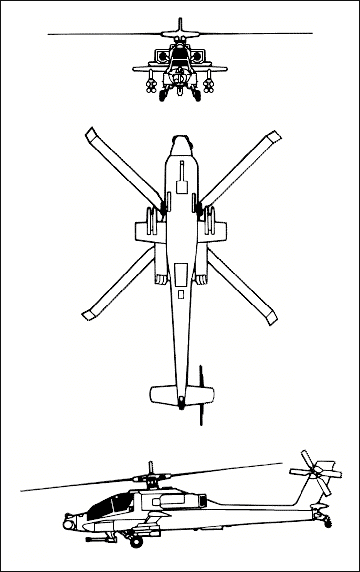
3-VIEW SCHEMATIC:
|
|
SOURCES:
|
|


|
Aircraft | Design | Ask Us | Shop | Search |

|
|
| About Us | Contact Us | Copyright © 1997- | |||
|
|
|||