|
||||||||||
|
|
||||||||||
|
||||||||||
|
|
||||||||||
 - -
 - -
 - -
 - -
|
|
|
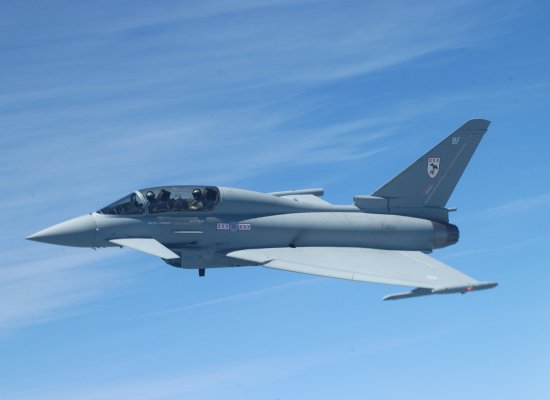
Eurofighter Typhoon Multi-Role Fighter |
|
DESCRIPTION:
The European Fighter Aircraft (EFA) program began in 1983 when France, Germany, Italy, Spain, and the UK agreed to develop a common air superiority fighter for the 21st century. France eventually pulled out of the program, as Germany almost did in 1992. Having survived numerous disagreements over workshares since that time, the effort finally culminated in the development of the Eurofighter 2000. Built jointly by British Aerospace (now BAE Systems), DASA, CASA, and Alenia, the aircraft was later rechristened simply as the Eurofighter. The plane has also been dubbed the Typhoon primarily for the export market. The Typhoon is optimized for the air defense mission but maintains a secondary ground attack capability. With its powerful advanced engines and canards, the aircraft is highly manueverable and capable of short takeoffs and landings. Despite significant delays due to escalating costs and political problems, the prototype EF2000 first flew in March 1994 and began entering service in 2003. Construction of the Typhoon has been divided over three major production runs known as tranches. Each tranche incorporates major changes in the production configuration while adding new capabilities to the aircraft. Further upgrades, primarily in software, are added as blocks or batches. Typhoon Tranch 1 entered production in 2002 with air-to-air capability achieved under Block 2. Full compatibility with air-to-ground weapons was implemented in Block 5. Development of Tranche 2 is now underway during which the Block 8 upgrade replaces obsolescent systems to support the integration of future weapons on the Eurofighter. The most controversial has proven to be Tranche 3 that was originally intended to integrate better engines, conformal fuel tanks, and an active electronically scanned array (AESA) radar. These upgrades have since been significantly scaled back or cancelled outright causing some partners to doubt whether Tranche 3 should be built at all. The project has been resuscitated by splitting into separate Tranche 3A and 3B efforts. Although all four partner countries have committed to Tranche 3A, only 112 arcraft have been ordered compared to the 236 Tranche 3 Typhoons originally envisioned. Tranche 3A should enter production in 2012 while development of Tranche 3B remains questionable. Italy and the UK have already cancelled plans for any Tranche 3B aircraft. A total of 610 Eurofighter Typhoon orders have been placed so far, including 180 for Germany, 160 for the UK, 96 for Italy, and 87 for Spain. Austria has also ordered 15 and Saudi Arabia is due to receive 72, but an order from Greece for 60 Typhoons was cancelled in 2004. About 148 of the production run are to be Tranche 1 models while 299 are Tranche 2 and 112 are Tranche 3A. A further 51 proposed Tranche 3 aircraft would presumably be deferred to Tranche 3B, should it be developed. Some 153 Typhoons have been delivered by late 2009, including 11 to Austria, 40 to Germany, 30 to Italy, 2 to Saudi Arabia, 19 to Spain, and 49 to the UK. The history of financial conflicts as well as the inability of the partner nations to agree on specific upgrades in each tranche have also damaged sales prospects to some export customers. The Typhoon has so far been unsuccessful in marketing attempts to Singapore and South Korea, but Japan is interested given America's unwillingness to sell the F-22. The Eurofighter consortium is also actively pursuing sales to other nations in Europe and Asia such as Romania, Oman, India, and Pakistan. Offers to Norway and Denmark were also underway until late 2007 when the Eurofighter consortium suspended talks over claims the F-35 was being given unfair advantages in the selection process.
Last modified 06 April 2011
|
|
| HISTORY: | |
| First Flight | 29 March 1994 |
| Service Entry |
June 2003
|
|
CREW:
|
(fighter) one: pilot (trainer) two: student pilot, instructor pilot |
| ESTIMATED COST: |
£63 million or $124 million [2008$]
|
| AIRFOIL SECTIONS: | |
| Wing Root | unknown |
| Wing Tip |
unknown
|
| DIMENSIONS: | |
| Length | 52.38 ft (15.96 m) |
| Wingspan | 34.46 ft (10.50 m) |
| Height | 17.33 ft (5.28 m) |
| Wing Area | 551.1 ft² (51.2 m²) |
|
Canard Area
|
25.83 ft² (2.40 m²)
|
| WEIGHTS: | |
| Empty | 22,045 lb (10,000 kg) |
| Normal Takeoff | 32,280 lb (15,550 kg) |
| Max Takeoff | 46,295 lb (21,000 kg) |
| Fuel Capacity |
internal: 8,820 lb (4,000 kg) external: two 395 gal (1,500 L) and one 265 gal (1,000 L) tanks |
|
Max Payload
|
14,300 lb (6,500 kg)
|
| PROPULSION: | |
| Powerplant | two Eurojet EJ2000 afterburning turbofans |
| Thrust |
26,980 lb (120 kN) 40,500 lb (180 kN) with afterburner |
| PERFORMANCE: | |
| Max Level Speed |
at altitude: 1,320 mph (2,125 km/h) at 36,090 ft (11,000 m), Mach 2.0 at sea level: unknown |
| Initial Climb Rate | unknown |
| Service Ceiling | unknown |
| Range |
typical: 2,000 nm (3,700 km) ferry: unknown |
| g-Limits |
+9.0 / -3.0
|
| ARMAMENT: | |
| Gun | one 27-mm Mauser cannon |
| Stations | thirteen external hardpoints |
| Air-to-Air Missile | AIM-9 Sidewinder, AIM-120 AMRAAM, Apside, ASRAAM, IRIS-T, Meteor |
| Air-to-Surface Missile | Storm Shadow, ALARM, Brimstone, Taurus |
| Bomb | 500-kg GP, 1,000-kg GP, GBU-24 LGB, Paveway II/III/IV, BL755 cluster |
| Other |
ECM pods, reconnaissance pods
|
| KNOWN VARIANTS: | |
| EAP | Experimental Aircraft Program funded by the UK and built by British Aerospace based on its Agile Combat Aircraft (ACA) research, served as testbed for Eurofighter systems |
| EFA | Designation for the original Eurofighter design which was cancelled due to high costs |
| DA1 to DA7 | Development Aircraft prototypes testing numerous engine and avionics configurations |
| IPA1 to IPA7 | Instrumented Production Aircraft built to a production standard configuration to test systems for the Series Production Aircraft |
| Tranche 1 | Initial production version; 148 to be built (Austria: 15, Germany: 33, Italy: 28, Spain: 19, UK: 53) |
| Block 1 | First production version of Tranche 1 providing initial operational capability |
| Block 2 | Software upgrade providing improved air-to-air capability |
| Block 2B | Software upgrade providing full air-to-air capability |
| Block 5 | Software upgrade supporting ground attack duties and achieving full operational capability, older aircraft were retrofitted to this standard |
| Tranche 2 | Second major version now entering production; 299 ordered (Germany: 79, Italy: 47, Saudi Arabia: 72, Spain: 34, UK: 67) |
| Block 8 | Upgrade to replace the mission computers required for advanced weapons like Storm Shadow and Meteor while also replacing other obsolescent equipment |
| Block 10 | Upgrade to several avionics systems and adding compatibility with new weapons including AMRAAM, IRIS-T, laser-guided bombs, and GPS-guided weapons |
| Block 15 | Expected to add compatibility with Storm Shadow, Taurus, Brimstone, and Meteor missiles |
| Block 20 | Future spiral development |
| Tranche 3 | Third major production version that may introduce a new radar; 163 planned (Germany: 68, Italy: 21, Spain: 34, UK: 40) |
| Tranche 3A | First phase of the Tranche 3 program built to the same standard as Tranche 2 but with provisions for future upgrades; 112 ordered (Germany: 31, Italy: 21, Spain: 20, UK: 40) |
| Tranche 3B | Second phase of the Tranche 3 program; 51 planned? (Germany: 37, Spain: 14) |
| C.16 Typhoon | Spanish designation for the Typhoon |
|
Typhoon T.1 Typhhon T.1A |
Two-seat trainers in the RAF, T.1A models use a modified fuel system |
| Typhoon F.2 | Single-seat Tranche 1 fighter model in the RAF |
| Typhoon F.3 | Two-seat Tranche 1 Block 5 or later fighters in the RAF |
|
Typhoon FGR.4
|
Single-seat Tranche 1 Block 5 or later fighters in the RAF capable of fighter, ground attack, or
reconnaissance missions
|
| KNOWN COMBAT RECORD: |
Libya - Operation Unified Protector / Ellamy (Italy, UK, 2011)
|
| KNOWN OPERATORS: |
Austria, Östereichische Luftstreitkräfte (Austrian Air Force) Germany, Deutsche Luftwaffe (German Air Force) Italy, Aeronautica Militare Italiana (Italian Air Force) Saudi Arabia, Al Quwwat al Jawwiya al Malakiya as Sa'udiya (Royal Saudi Air Force) Spain, Ejército del Aire Española (Spanish Air Force) United Kingdom (Royal Air Force) |
|
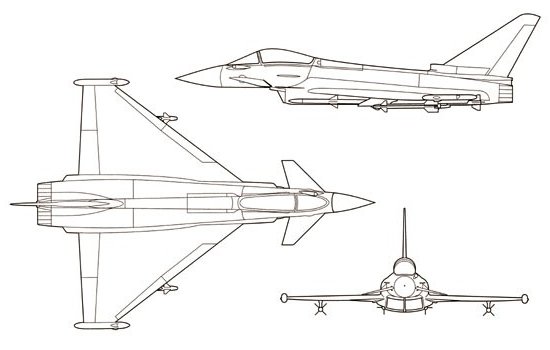
3-VIEW SCHEMATIC:
|
|
SOURCES:
|
|


|
Aircraft | Design | Ask Us | Shop | Search |

|
|
| About Us | Contact Us | Copyright © 1997- | |||
|
|
|||