|
||||||||||
|
|
||||||||||
|
||||||||||
|
|
||||||||||
 - -
|
|
|
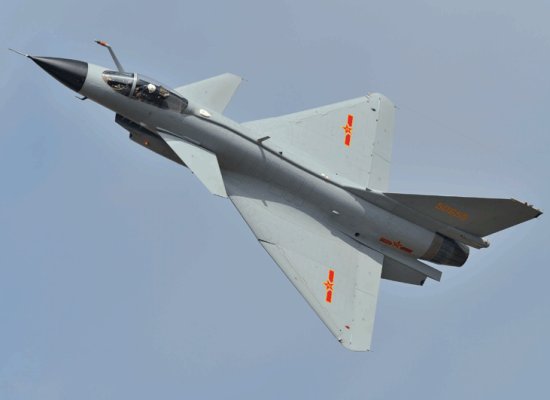
Chengdu J-10, F-10 ASCC codename: unknown Multi-Role Fighter |
|
DESCRIPTION:
The Jianjiji-10 Fighter Aircraft 10 (J-10) "Vigorous Dragon" project began in the mid-1980s. The goal of the program appears to be the development of an indigenous Chinese multi-role fighter equivalent to the Mirage 2000 operated by Taiwan. The J-10 is reportedly similar to the American F-16 and a cancelled Israeli fighter based on the F-16 called the Lavi. Although Israel denies transferring any unauthorized technology, it is known Israeli companies supplied assistance in J-10 development. Pakistan also reportedly provided one of its F-16s to China for study, and several Russian engineers who worked on the J-10 indicated a Lavi prototype was located in Chengdu's facilities. The resulting design, very similar to the Lavi externally, features a delta wing with canards mounted just aft of the cockpit. The J-10 is powered by a single Russian AL-31F turbofan, but there is speculation this engine may only be used on prototypes and early production models until China is able to substitute a domestically-developed WS-10A turbofan. Early artist impressions indicated an F-16 style engine inlet, but the prototype emerged with a rectangular inlet reminiscent of the Eurofighter Typhoon. Like the engine, many J-10 avionics are also of Russian origin. The radar for full-rate production models is still something of a mystery, but the most likely candidate is a Chinese pulse Doppler planar array copied from Russian and Israeli technology. The cockpit features a layout of LCD displays, HUD, and helmet-mounted sight typical of contemporary fighters. The J-10 is envisioned as a multi-role fighter replacing the obsolescent Q-5 and J-7 and armed with much improved weapons. In the air interceptor role, the J-10 will likely be armed with the PL-8 infrared-homing short-range missile (a copy of the Israeli Python 3) and the radar-homing medium-range PL-11 or PL-12. A variety of precision-guided bombs and air-to-ground missiles are also expected to be fielded for surface attack and anti-ship missions. Much of the J-10's history has been clouded in mystery. Official authorization for the project appears to have been given in 1986 or 1988 with a mock-up completed by late 1993. However, this initial design was predicted to have poor performance, and evolving requirements for a multi-role fighter instead of an air-superiority aircraft forced redesign and development delays. Some reports suggest prototype 1001 first flew in mid-1996 and the second prototype 1002 suffered a fatal accident in 1997. The Chinese government refutes these claims and announced first flight came on 23 March 1998. Detractors doubt this explanation believing this to be the resumption of flight testing after the accident, but China maintains no incidents have occurred during testing. Some 140 flight tests had been completed by late 2000 with nine prototypes, static test airframes, and pre-production aircraft built by mid-2002. The first two-seat J-10S appeared in 2003, the same year that single-seat J-10A models were delivered for operational evaluation. Service entry was achieved by 2005. Rumors emerged in 2006 of a new improved model called the J-10B that incorporates advanced features. Among these are a redesigned diverterless engine inlet similar to that used by the X-32, an electro-optical targeting system (EOTS) including an infrared search and track (IRST) camera and laser rangefinder mounted forward of the canopy, and an enlarged vertical tail housing electronic warfare or electronics countermeasures equipment. It is anticipated the J-10B will become the future production standard. Although it is believed some 300 J-10s are on order for the Chinese Air Force and Navy, the decision to license-build the Russian Su-27 (aka the J-11) suggests a possible lack of confidence in the ultimate success of the J-10 design. Some reports indicate China is developing a new model called the J-10C as a fighter bomber and abandoning the air superiority role given disappointment in the J-10's performance compared to the Su-27. Approximately 120 J-10 fighters were built by 2008. An F-10 export variant is in development, and Pakistan has ordered 36 under the designation FC-20. Iran has also shown interest and reportedly made a deal for 24 F-10 fighters in 2007, but China has denied the rumor. A navalized version, possibly confused with the J-10B, for use on a future Chinese aircraft carrier has also been suggested but no details are known.
Data below subject to change as more information becomes available |
|
| HISTORY: | |
| First Flight |
(J-10A) 23 March 1998 (J-10S) 26 December 2003 (J-10B) December 2008 |
| Service Entry | 2004 or 2005 |
| CREW: | one: pilot |
| COST: |
(J-10A) $28 million [2008$] (FC-20) $41 million [2008$] |
| DIMENSIONS: | |
| Length | 47.92 ft (14.57 m) |
| Wingspan | 28.81 ft (8.78 m) |
| Height | 15.69 ft (4.78 m) |
| WING: | |
| Root Airfoil Section | unknown |
| Tip Airfoil Section | unknown |
| Area | 356.3 ft² (33.10 m²) |
| Aspect Ratio | 2.33 |
| Control Surface Areas |
inboard elevons: unknown outboard elevons: unknown leading-edge slats: unknown |
| TAIL: | |
| Tailfin Area | unknown, equipped with a swept dorsal fin and two canted ventral fins |
| Control Surface Areas | rudder: unknown |
| FOREPLANE: | |
| Canard Span | unknown |
| Canard Area | 58.66 ft² (5.45 m²) |
| Control Surface Areas | 58.66 ft² (5.45 m²) |
| UNDERCARRIAGE: | |
| Type | Retractable tricycle with two main gear and single steerable nose gear |
| Main Gear | Single wheel per unit, tire size unknown |
| Nose Gear | Two wheels per unit, tire size unknown |
| Wheel Track | unknown |
| Wheel Base | unknown |
| WEIGHTS & LOADINGS: | |
| Empty | 21,495 lb (9,750 kg) |
| Normal Takeoff | unknown |
| Maximum Takeoff | 40,785 lb (18,500 kg) |
| Maximum Landing | unknown |
| Internal Fuel Capacity | 9,920 lb (4,500 kg) in 1,310 gal (4,950 L) fuselage and wing tanks |
| External Fuel Capacity | 4,770 lb (2,165 kg) in two 420 gal (1,600 L) and one 210 gal (800 L) tanks |
| Maximum Payload | 9,920 lb (4,500 kg) |
| Wing Loading | 85.0 lb/ft² (415.0 kg/m²) |
| Thrust/Weight Ratio | 0.98 |
| PROPULSION: | |
| Powerplant | one Saturn/Lyulka AL-31FN afterburning turbofan |
| Engine Rating |
1 x 17,855 lb (79.4 kN) 1 x 27,560 lb (122.6 kN) with afterburner |
| Engine Intakes | One variable geometry inlet on fuselage chin |
| Fuel Type | unknown |
| PERFORMANCE: | |
|
Max Level Speed (at altitude) |
Mach 1.85 |
|
Max Level Speed (at sea level) |
915 mph (1,470 km.h), Mach 1.2 |
| Cruise Speed | unknown |
| Takeoff Speed | unknown |
| Landing Speed | unknown |
| Takeoff Distance | 1,150 ft (350 m) |
| Landing Distance | unknown |
| Maximum Climb Rate | unknown |
| Service Ceiling | 59,050 ft (18,000 m) |
| Combat Radius | 300 nmi (555 km) |
| Ferry Range | 1,000 nmi (1,850 km) |
| Endurance | unknown |
| g-Limits | +9.0 / -3.0 |
| SYSTEMS: | |
| Crew Escape | Zero-zero ejection seat |
| Radar |
(prototypes) Type 1473 indigenously-produced radar (J-10A) Nanjing Research Institute of Electronic Technology KLJ-10 multi-mode mechanically scanned planar array pulse Doppler system based on the Russian Phazotron Zhuk and Zhemchug as well as the Israeli Elta EL/M-2035 (FC-20) Italian FIAR Grifo 2000/16 (J-10B) phased array radar? |
| Avionics | 1553B databus, air data computer, wide angle holographic head up display (HUD), three liquid crystal multi-function displays, helmet-mounted weapon sight |
| Self-protection | Radar warning receiver, BM/KG300G active jammer pod, electronic countermeasures system |
| Flight Controls | Type 634 quadruplex digital fly-by-wire |
| In-Flight Refueling | Fixed probe mounted on starboard side |
| Airbrakes | Single unit on each side of rear fuselage |
| COMPOSITION: |
|
| ARMAMENT: | |
| Gun | one 23-mm cannon |
| Stations | eleven external hardpoints: centerline, tandem pairs on sides of fuselage, three under each wing |
| Air-to-Air Missile | up to two PL-8 or PL-9, up to four PL-11 or PL-12 |
| Air-to-Surface Missile | C-801/YJ-8 or C-802/YJ-82 anti-ship, YJ-91 anti-radiation |
| Bomb | up to two 500-kg laser-guided, up to six 250-kg GP |
| Other | up to four 19-mm rocket pods, FILAT (Forward-looking Infra-red Laser Attack Targeting) pod, Blue Sky FLIR (Forward Looking Infra-red) pod, KZ900 SIGINT (SIGnals INTelligence) pod |
| VARIANTS: | |
| J-10A | Production single-seat attack fighter |
| F-10A | Export model of the J-10A |
| J-10S | Production two-seat trainer with a lengthened forward fuselage for the instructor pilot and an enlarged dorsal spine possibly for avionics or fuel, may also be developed as an electronic countermeasures jammer aircraft or a ground attack model with the second crew member operating mission equipment |
| Super 10 or J-10B | Upgraded model that may include a more powerful AL-31FN M1 engine, a refined diverterless air intake, a 2D or 3D thrust vectoring nozzle, a strengthened airframe, modified vertical tail and ventral fins, an electro-optical targeting system (EOTS) with an infrared search and track (IRST) camera and laser rangefinder, new electronics countermeasures equipment, and a modified nose for a passive phased-array radar |
| J-10BS | Possible designation for a two-seat version of the J-10B |
| J-10C | Rumored two-seat model emphasizing ground attack owing to disappointment in the fighter capabilities of the J-10A, the second seat being devoted to a weapon systems officer |
| FC-20 | Designation for the F-10 in Pakistan with some modifications required by the Pakistanis; at least 36 ordered with delivery to start in 2014 or 2015 |
| COMBAT HISTORY: | |
|
|
none |
| OPERATORS: | |
|
|
China, Zhongkuo Shenmin Taifang Tsunputai (People's Liberation Army Air Force) Pakistan, Pakistan Fiza'ya (Pakistani Air Force) |
|
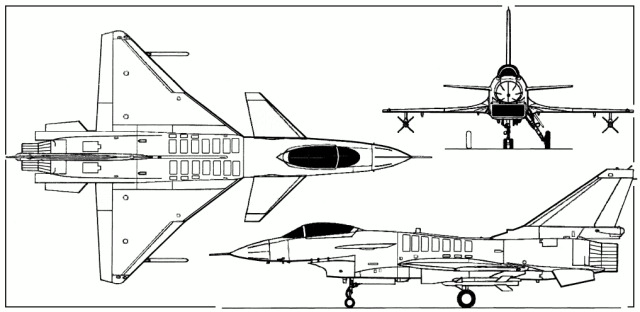
3-VIEW DIAGRAM:
|
|
SOURCES:
|
|
|
|
|


|
Aircraft | Design | Ask Us | Shop | Search |

|
|
| About Us | Contact Us | Copyright © 1997- | |||
|
|
|||