|
||||||||||
|
|
||||||||||
|
||||||||||
|
|
||||||||||
 - -
|
|
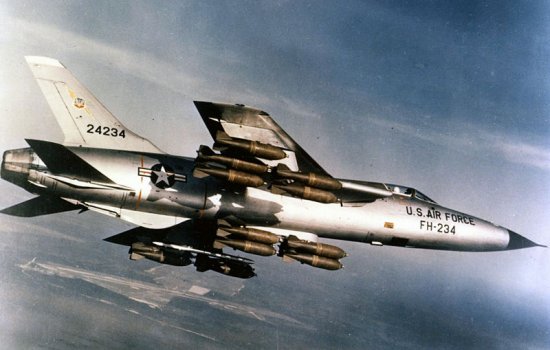
|
Republic F-105 Thunderchief Fighter Bomber |
|
DESCRIPTION:
The F-105 was a rugged fighter bomber used widely during the early part of the Vietnam War. The design was notable in many respects, including its large bomb bay, unique forward-swept engine inlets at the wing root, and the fact that it remains the largest single-seat combat aircraft ever built. The F-105 was developed as a replacement for the F-84F Thunderstreak low-altitude fighter bomber during a period when the US Air Force was focused on building up its nuclear deterrence capabilities. The F-105 was optimized to carry a nuclear payload while flying supersonically at low altitudes to penetrate the advanced air defenses of the Soviet Union. This mission concept required an internal bomb bay with a powerful engine and high wing loading to minimize drag and maximize crew comfort in the demanding flight environment. The plane also required a voluminous interior not only for the bulky nuclear weapon but for a large fuel capacity and a radar in the nose. Impressed by the new design, the Air Force initially placed an order for 199 Thunderchiefs in 1952. As the Korean War came to an end, however, the USAF began losing interest and cut its order to just 46 F-105A models. Unfortunately, the YF-105 prototypes proved underpowered thanks to disappointing performance of early turbojets, significant weight growth, and unexpectedly high transonic drag. Rectifying these problems extended development by requiring integration of a more powerful Pratt & Whitney engine and forcing a redesign of the fuselage conforming to the area rule, similar to that of the F-102. Despite these teething troubles, the F-105 eventually emerged as one of the most numerous tactical fighters of its era. The first production model was the F-105B featuring the improved engine and aerodynamic changes described above as well as a better fire control system. Thanks to its remarkable payload capacity and flight performance, the USAF ordered over 1,500 F-105D models as all-weather ground attack bombers. However, these plans were curtailed by Secretary of Defense Robert McNamara who cut F-105D production to just 600 units and directed the Air Force to buy the Navy's F-4 instead. Also called the 'Ultra Hog,' 'Lead Sled,' and 'Thud' by its pilots, the Thunderchief was originally intended as a long-range tactical bomber carrying a single nuclear weapon in its enormous bomb bay. During the Vietnam War, however, the F-105 was used extensively as a conventional attack aircraft striking targets throughout the heavily defended North Vietnam. Most weapons were carried externally on centerline or wing pylons while the bomb bay was taken up by a fuel tank. Typical armaments included an internal cannon with a radar-ranging gunsight, Sidewinder air-to-air missiles for self-defense, and five 1,000 lb (454 kg) or six 750 lb (340 kg) conventional bombs. Later in the war, the EF-105F and F-105G were introduced as dedicated defense-suppression aircraft. These 'Wild Weasel' planes were designed to detect and locate enemy air defense sites and attack them with Shrike or Standard anti-radar missiles. The F-105 began entering service in 1958 and remained in use for nearly 30 years. The F-105B was phased out of front-line duty and transferred to the Air National Guard (ANG) by 1964, but the definitive F-105D ultimately equipped thirteen tactical fighter wings. This model bore the brunt of the tactical bombing campaign over Vietnam until it was withdrawn from the war in 1970 following heavy losses. The survivors returned to the US and began equipping Reserve and ANG units starting in 1971. After the war drew to a close, much of the remaining F-105 fleet was retired, although significant numbers continued in service with the Reserves and National Guard into the 1980s. The last model to see front-line service was the F-105G Wild Weasel that finally departed the USAF for a reserve unit in 1980. The last Thunderchiefs soldiered on for a few more years until the F-105D completed its final operational flight for the Reserves in 1984. A total of 833 F-105 aircraft were ultimately built. Of these, 395 were lost in combat over Vietnam. AAA fire and surface-to-air missiles accounted for the vast majority of these losses having claimed a staggering 312 of the F-105 fleet. Though not intended as a defense fighter, the Thunderchief held its own in aerial combat suffering 22 losses to Vietnamese MiG fighters while claiming 27.5 kills, most of these with its internal cannon. Another 61 losses were credited to operational accidents while 226 succumbed to accidents in training or peacetime service. Of the remainder, 109 were scrapped and 103 survive today as static displays. The F-105 was replaced by the F-16.
Data below for F-105F/G |
|
| HISTORY: | |
| First Flight |
(YF-105A) 22 October 1955 (F-105B) 26 May 1956 (F-105D) 9 June 1959 (F-105F) 11 June 1963 |
| Service Entry | August 1958 |
| Retirement |
25 February 1984
|
|
CREW:
|
(F-105B/D) one: pilot (F-105F/G) two: pilot, systems officer |
|
ESTIMATED COST:
|
(F-105D) $2.2 million [1960$]
|
| AIRFOIL SECTIONS: | |
| Wing Root | NACA 65A005.5 |
| Wing Tip |
NACA 65A003.7
|
| DIMENSIONS: | |
| Length | 69.63 ft (21.21 m) |
| Wingspan | 34.94 ft (10.65 m) |
| Height | 20.17 ft (6.15 m) |
| Wing Area | 384.3 ft² (35.77 m²) |
|
Canard Area
|
not applicable
|
| WEIGHTS: | |
| Empty | 28,393 lb (12,879 kg) |
| Normal Takeoff | unknown |
| Max Takeoff | 54,000 lb (24,495 kg) |
| Fuel Capacity |
internal: 7,900 lb (3,580 kg) in seven tanks totaling 1,160 gal (4,460 L) external: 13,190 lb (5,985 kg) in one 390 gal (1,475 L) bomb bay tank, one 650 gal (2,460 L) centerline tank, and two 450 gal (1,705 L) wing tanks |
|
Max Payload
|
14,000 lb (6,350 kg)
|
| PROPULSION: | |
| Powerplant | one Pratt & Whitney J75-19W afterburning turbojet |
|
Thrust
|
24,500 lb (109.0 kN)
|
| PERFORMANCE: | |
| Max Level Speed |
at altitude: 1,390 mph (2,235 km/h) at 36,000 ft (10,975 m), Mach 2.1 at sea level: unknown |
| Initial Climb Rate | 32,000 ft (9,750 m) / min |
| Service Ceiling | 52,000 ft (15,850 m) |
| Range |
typical: 400 nm (740 km) ferry: 2,080 nm (3,850 km) |
| g-Limits |
unknown
|
| ARMAMENT: | |
| Gun | one 20-mm M-61A1 cannon (1,029 rds) |
| Stations | one internal weapon bay and five external hardpoints |
| Air-to-Air Missile | up to four AIM-9 Sidewinder |
| Air-to-Surface Missile |
(F-105D) up to four AGM-12 Bullpup (F-105G) AGM-45 Shrike, AGM-78 Standard |
| Bomb | one Mk 28 or Mk 43 nuclear weapon, up to two 3,000-lb bombs, up to five 1,000-lb bombs, up to 16 750-lb bombs, Mk 77 Napalm |
| Other |
ECM pods, 2.75-in rocket pods
|
| KNOWN VARIANTS: | |
| YF-105A | Original prototype with an underpowered engine that did not go into production; 2 built |
| F-105A | Planned production model cancelled in favor of the improved F-105B; 37 fighter bomber and 9 reconnaissance models had been ordered before the cancellation |
| YF-105B | Improved prototype and pre-production models with an upgraded engine fed by forward-swept inlets and a new fuselage shape dictated by the area rule; 4 built |
| F-105B | First production single-seat fighter bomber; 71 built |
| RF-105B | Proposed reconnaissance model based on the F-105B; 3 prototypes built but a production model was cancelled |
| JF-105B | Test aircraft re-built from the prototype RF-105B airframes and used for special trials; 3 converted |
| F-105C | Proposed two-seat trainer; not built |
| F-105D | Definitive single-seat all-weather fighter bomber with a lengthened fuselage for a new multi-mode radar providing terrain-following capability and aerial as well as surface attack modes, a new fire control system to improve navigation and weapon accuracy, a more powerful engine, and better avionics; 610 built |
| RF-105D | Proposed reconnaissance model based on the F-105D; not built |
| F-105E | Proposed two-seat trainer based on the F-105D; not built |
| F-105F | Two-seat combat-capable trainer based on the F-105D; 143 built |
| EF-105F | Re-built F-105F models equipped with radar homing and jamming equipment for use as defense suppression aircraft; 86 converted |
| F-105G |
Two-seat defense suppression model with electronic countermeasures, radar homing, and jamming equipment as
well as compatiblity with AGM-45 and AGM-78 missiles; 61 converted from F-105F and EF-105F airframes
|
| KNOWN COMBAT RECORD: |
Vietnam War (USAF, 1965-1970)
|
| KNOWN OPERATORS: |
United States (US Air Force) United States (US Air Force Reserves) United States (US Air National Guard) |
|
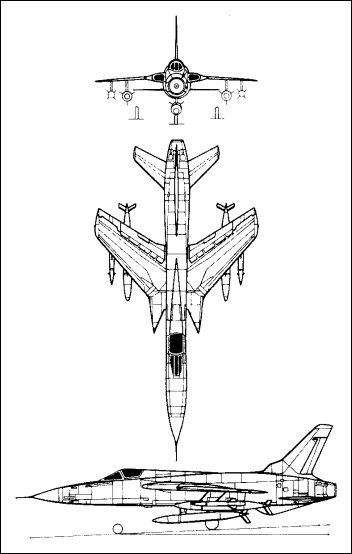
3-VIEW SCHEMATIC:
|
|
SOURCES:
|
|


|
Aircraft | Design | Ask Us | Shop | Search |

|
|
| About Us | Contact Us | Copyright © 1997- | |||
|
|
|||