|
||||||||||
|
|
||||||||||
|
||||||||||
|
|
||||||||||
 - -
 - -
|
|
|
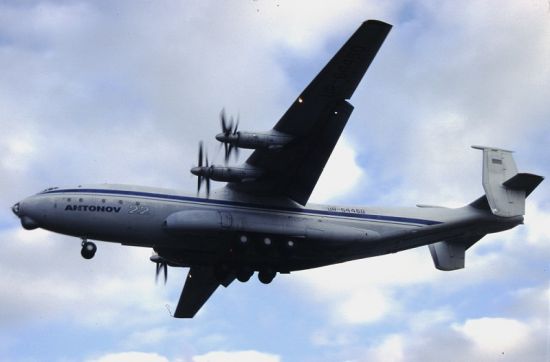
Antonov An-22 Antei ASCC codename: Cock Heavy Transport |
|
DESCRIPTION:
Until the advent of the C-5 Galaxy, the An-22 Antei (Antheus) was the world's largest aircraft, and the design remains the world's largest turboprop-powered airplane. The An-22 follows traditional cargo transport design with a high-mounted wing allowing a cargo space 108 ft (33 m) in length and with a usable volume of 22,500 ft³ (639 m³). The An-22 is essentially an enlarged version of the earlier An-12 except the tail was redesigned to incorporate twin vertical tails. Key to the An-22's performance is its four powerful turboprop engines, each employing contra-rotating propellers that generate a significant slipstream over the wings. Combined with large double-slotted flaps along the wing trailing edge, the An-22 is capable of operating from relatively short runways for a plane of its size. The powerful engines have also allowed the An-22 to set a number of payload and payload-to-height world records. The landing gear are ruggedized for operations from rough airstrips, and the tire pressures can be adjusted in flight for optimum landing performance. A pressurized forward fuselage provides space for 5 to 8 crew and up to 28 passengers, but the cargo space is unpressurized allowing the rear cargo doors to be opened during flight for paradrops. Although 100 examples of the An-22 were ordered for the Soviet Air Force and Aeroflot, only about half of these are actually believed to have been built. Approximately 45 remained in service by the mid-1990s, mostly with the Russian Air Force, but these are slowly being replaced by the An-124.
Last modified 12 February 2011
|
|
| HISTORY: | |
| First Flight | 27 February 1965 |
|
Service Entry
|
1968 (?)
|
| CREW: |
five: pilot, co-pilot, flight engineer, navigator, radio operator
|
| PASSENGERS: |
28
|
|
ESTIMATED COST:
|
unknown
|
| AIRFOIL SECTIONS: | |
| Wing Root | unknown |
|
Wing Tip
|
unknown
|
| DIMENSIONS: | |
| Length | 189.96 ft (57.90 m) |
| Wingspan | 211.28 ft (64.40 m) |
| Height | 41.11 ft (12.53 m) |
| Wing Area | 3,713.67 ft² (345.00 m²) |
|
Canard Area
|
not applicable
|
| WEIGHTS: | |
| Empty | 251,325 lb (114,000 kg) |
| Normal Takeoff | unknown |
| Max Takeoff | 551,155 lb (250,000 kg) |
| Fuel Capacity | unknown |
|
Max Payload
|
176,370 lb (80,000 kg)
|
| PROPULSION: | |
| Powerplant | four Kuznetsov NK-12MA turboprops |
| Thrust |
60,000 shp (44,744 kW)
|
| PERFORMANCE: | |
| Max Level Speed |
at altitude: 460 mph (740 km/h) at sea level: unknown cruise speed: 375 mph (600 km/h) |
| Initial Climb Rate | unknown |
| Service Ceiling | 32,780 ft (10,000 m) |
| Range |
typical: 2,700 nm (5,000 km) with max payload ferry: 5,910 nm (10,950 km) |
| g-Limits |
unknown
|
| ARMAMENT: | |
| Gun | none |
| Stations | none |
| Air-to-Air Missile | none |
| Air-to-Surface Missile | none |
| Bomb | none |
| Other |
none
|
| KNOWN VARIANTS: | |
| An-22 | Production model for a heavy transport; between 50 and 100 built |
| (?) | A model exists that carries outsize cargo piggy-back above the fuselage, can be distinguished by a third tailfin |
| (?) |
Proposed civil airliner version to seat 724 passengers on upper and lower decks; not built
|
|
KNOWN COMBAT RECORD:
|
Yom Kippur War (Soviet Union, 1973)
|
| KNOWN OPERATORS: | |
| Civil | Aeroflot |
| Military |
Russia, Voyenno Vozdushniye Sili (Russian Air Force) Union of Soviet Socialist Republics, Voyenno Vozdushniye Sili (Soviet Air Force) |
|
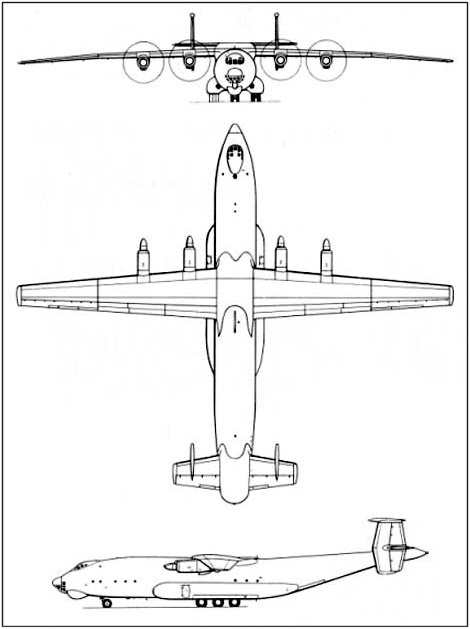
3-VIEW SCHEMATIC:
|
|
SOURCES:
|
|


|
Aircraft | Design | Ask Us | Shop | Search |

|
|
| About Us | Contact Us | Copyright © 1997- | |||
|
|
|||