|
||||||||||
|
|
||||||||||
|
||||||||||
|
|
||||||||||
 - -
|
|
|
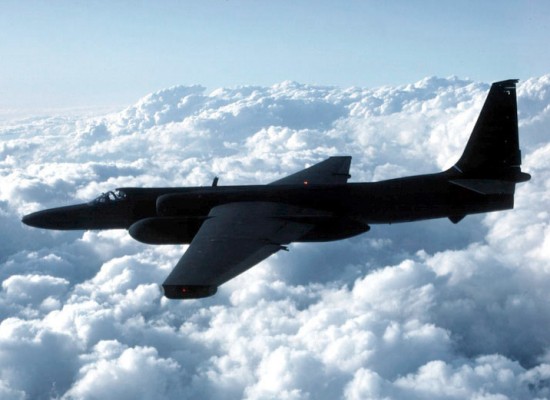
Lockheed U-2 Dragon Lady Tactical Reconnaissance |
|
DESCRIPTION:
The U-2 spyplane was originally developed by the 'Skunkworks' division of Lockheed while working under strict secrecy. The revolutionary new plane was envisioned as a high-altitude reconnaissance aircraft for the Central Intelligence Agency and the US Air Force. The 'U' designation, normally used for an innocuous utility aircraft, was used as part of a campaign to keep the aircraft a mystery from prying eyes. In order to further hide the U-2's true purpose, the first operational squadron was officially called a "Weather Reconnaissance" unit operated by NASA. The first two squadrons were based in Japan and Germany or England from which the aircraft flew numerous missions over the Soviet Union, China, Vietnam, and the Middle East. The U-2 also proved vital in 1962 when its pilots discovered the placement of nuclear missile bases in Cuba leading to the Cuban Missile Crisis. It was not until 1 May 1960 that the world learned the truth about the U-2 after one flown by Francis Gary Powers was shot down deep within the Soviet Union. Though Powers was later returned to the US in exchange for a Soviet spy, the U-2 never entered Soviet airspace again. Attrition was high since the aircraft was so difficult to fly and other examples were shot down over China and Cuba. In light of these losses, a new model, the U-2R, entered production in 1968. The most recent version is the U-2S. Originally designated as the TR-1, the U-2S is an updated U-2R carrying an advanced Synthetic-Aperture Radar capable of scanning 35 miles within enemy territory while the aircraft remains in international airspace. The TR-1, U-2R, and U-2S can be differentiated from older U-2 variants by the large avionics pod mounted beneath each wing. The U-2S remains in service today and has seen extensive use over Iraq and Afghanistan. Due to the age of the remaining U-2 fleet, the Dragon Lady may be retired and replaced by unmanned aircraft like the RQ-4 Global Hawk.
Data below for U-2C, U-2R, and U-2S where indicated |
|
| HISTORY: | |
| First Flight |
(U-2A) 1 August 1955 (TR-1A/U-2S) August 1981 |
|
Service Entry
|
(U-2A) June 1957 (U-2S) October 1994 |
| CREW: |
one: pilot
|
|
ESTIMATED COST:
|
unknown
|
| AIRFOIL SECTIONS: | |
| Wing Root | NACA 64A409 |
|
Wing Tip
|
NACA 64A406
|
| DIMENSIONS: | |
| Length |
(U-2C) 49.95 ft (15.24 m) (U-2S) 63.00 ft (19.2 m) |
| Wingspan |
(U-2C) 80.00 ft (24.38 m) (U-2S) 103.00 ft (31.39 m) |
| Height | 14.98 ft (4.57 m) |
| Wing Area |
(U-2C) 565 ft² (52.49 m²) (U-2S) 1,000 ft² (92.9 m²) |
|
Canard Area
|
not applicable
|
| WEIGHTS: | |
| Empty |
(U-2C) 11,700 lb (5,305 kg) (U-2R) 19,000 lb (8,620 kg) (U-2S) 17,800 lb (8,075 kg) |
| Normal Takeoff | unknown |
| Max Takeoff |
(U-2C) 17,270 lb (7,833 kg) (U-2S) 40,000 lb (18,144 kg) |
| Fuel Capacity |
internal: unknown external: unknown |
|
Max Payload
|
unknown
|
| PROPULSION: | |
| Powerplant |
(U-2C) one Pratt & Whitney J75-13 turbojet (U-2R/TR-1A) one Pratt & Whitney J75-13B turbojet (U-2S) one General Electric F-118-101 turbofan |
| Thrust |
(U-2R) 17,000 lb (75.6 kN) (U-2S) 19,000 lb (84.5 kN) |
| Fuel Type |
JPTS
|
| PERFORMANCE: | |
| Max Level Speed |
at altitude: 530 mph (850 km/h) [U-2C] 495 mph (795 km/h) [U-2S] at sea level: unknown cruise speed: 375 mph (690 km/h) [U-2R] |
| Initial Climb Rate | unknown |
| Service Ceiling |
(U-2C) 85,000 ft (25,930 m) (U-2S) 90,000 ft (27,430 m) |
| Range |
(U-2C/R) 2,610 nm (4,830 km) (U-2S) 3,800 nm (7,050 km) |
| Endurance |
(U-2R) 12 hr (U-2S) 15 hr |
| g-Limits |
+2.5
|
| ARMAMENT: | |
| Gun | none |
| Stations |
(U-2C) one internal bay (U-2S) one internal bay and two underwing pods |
| Air-to-Air Missile | none |
| Air-to-Surface Missile | none |
| Bomb | none |
| Other |
cameras, IR sensors, other recon sensors
|
| KNOWN VARIANTS: | |
| U-2A | First production single-seat reconnaissance model; 48 built |
| U-2B | Two-seat trainer; 5 built |
| U-2C | Improved single-seat reconnaissance model with a new engine and modified engine inlets |
| U-2D | Two-seat trainer |
| U-2CT | Two-seat trainer rebuilt from U-2D airframes but with the training pilot seated at a higher level; at least 6 converted |
| U-2E | Two-seat U-2B airframes fitted with in-flight refueling equipment to double the range, but this capability was seldom used |
| U-2F | Single-seat U-2C aircraft modified with in-flight refueling equipment similar to the U-2E |
| U-2G | U-2A airframes modified with stronger landing gear, an arresting hook, and wing spoilers in order to operate from US Navy aircraft carriers; 3 converted but rarely used |
| U-2H | Lone aircraft fitted with both in-flight refueling gear and capable of operating from an aircraft carrier |
| U-2R | Enlarged and improved U-2C with underwing pods and increased fuel capacity; 12 built |
| U-2RT or TU-2R | Two-seat trainer based on the U-2R; 1 built |
| U-2EPX | Proposed maritime surveillance model for the US Navy based on the U-2R; 2 built but not put into service |
| WU-2 | Research aircraft used by the US Air Force for weather and atmospheric research |
| TR-1A | Improved U-2R with a side-scanning radar, new avionics, and improved ECM equipment; 33 built (and later redesignated as U-2R aircraft) |
| TR-1B | Two-seat trainer based on the TR-1A; 2 built (and later redesignated as U-2RT) |
| ER-2 | Single-seat "earth resource" research aircraft built for NASA, NASA originally acquired and modified two U-2C aircraft in 1971 and later receieved a single new-build ER-2 (based on the TR-1) in 1981 |
| U-2S | New designation for the U-2R/TR-1A fleet after being updated with a more efficient engine, improved sensors, and the addition of a GPS system; 31 converted |
| U-2ST or TU-2S |
Redesignated U-2RT/TR-1B two-seat trainer with an updated engine; 4 converted
|
|
KNOWN COMBAT RECORD:
|
overflights of Soviet Union, China, Cuba, and others Vietnam War (USAF, 1965-1972) Iraq - Operation Desert Storm (USAF, 1991) Iraq - Operation Northern Watch (USAF, 1991-2003) Iraq - Operation Southern Watch (USAF, 1991-2003) Bosnia - Operation Deliberate Force (USAF, 1995) Afghanistan - Operation Enduring Freedom (USAF, 2001-present) Iraq - Operation Iraqi Freedom (USAF, 2003-present) Libya - Operation Odyssey Dawn (USAF, 2011) |
|
KNOWN OPERATORS:
|
United States (Central Intelligence Agency) United States (US Air Force) United States (NASA) |
|
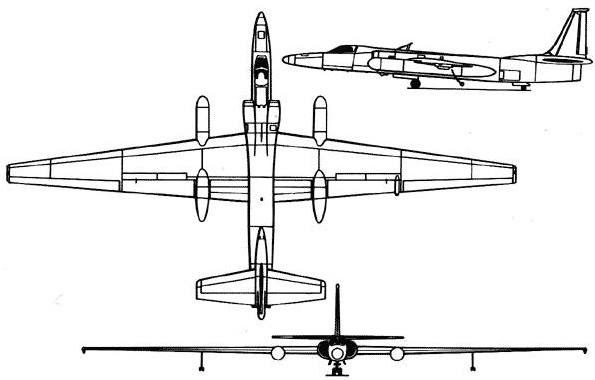
3-VIEW SCHEMATIC:
|
|
SOURCES:
|
|


|
Aircraft | Design | Ask Us | Shop | Search |

|
|
| About Us | Contact Us | Copyright © 1997- | |||
|
|
|||