|
||||||||||
|
|
||||||||||
|
||||||||||
|
|
||||||||||
 - -
|
|
|
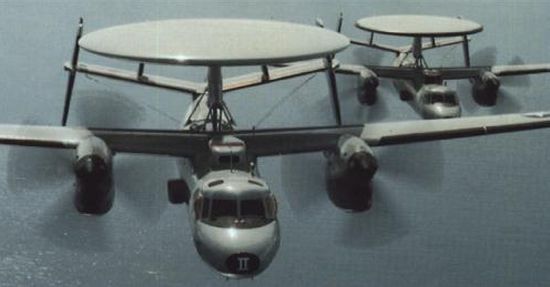
Grumman E-2 Hawkeye Airborne Early Warning And Control Aircraft |
|
DESCRIPTION:
Although the US Navy had long desired an airborne surveillance platform, it took several years for electronics to sufficiently decrease in size to be fitted within an aircraft that could operate from an aircraft carrier. Even so, it took several more years for computers to become powerful enough that they could track and process more than a few targets at once. These conditions were finally met, however, culminating in Grumman being named the winner of a Navy contract to develop an airborne early warning and control (AWACS) aircraft. The Grumman design featured twin turboprop engines fitted beneath a high-mounted wing. The long fuselage housed a crew of five, including three mission specialists, and featured a large rotating radome mounted on a pylon above the wing juncture. To compensate for the airflow around the radome, the tail assembly incorporated four fins on a horizontal tail with significant dihedral. This design, first flown in 1960, was originally known as the W2F-1 but was later redesignated the E-2A Hawkeye before entering service. The Navy took delivery of 59 E-2A airframes by 1967, but these were quickly upgraded to the E-2B standard with the installation of a more powerful processing computer and inflight-refueling equipment. Shortly thereafter, Grumman began production of the E-2C model with far superior avionics and more powerful engines. These aircraft have been continuously upgraded with new radar and sensors, improved avionics, more powerful processing equipment, and software upgrades allowing the E-2C Hawkeye to track over 250 targets and control 30 interceptors at once. In addition to protecting the US fleet, the E-2 has also been used in cooperation with law enforcement agencies to interdict drug trafficers. The E-2 has also proven popular with the French Navy and a variety of foreign air forces. As production of the E-2C has wound down, development of a new variant called the E-2D with improved electronics is underway. The US Navy currently plans to purchase 75 of the E-2D model with deliveries beginning in 2010.
Data below for E-2C |
|
| HISTORY: | |
| First Flight |
(W2F-1) 21 October 1961 (E-2C) 20 January 1971 |
|
Service Entry
|
(E-2A) 19 January 1964 (E-2C) November 1973 |
| CREW: |
2 pilots, 1 radar operator, 1 air control officer, 1 combat information center officer
|
|
ESTIMATED COST:
|
$51 million
|
| AIRFOIL SECTIONS: | |
| Wing Root | NACA 63A216 |
|
Wing Tip
|
NACA 63A414
|
| DIMENSIONS: | |
| Length | 57.56 ft (17.54 m) |
| Wingspan | 80.58 ft (24.56 m) |
| Height | 18.31 ft (5.58 m) |
| Wing Area | 700.0 ft² (65.03 m²) |
|
Canard Area
|
not applicable
|
| WEIGHTS: | |
| Empty | 37,945 lb (17,210 kg) |
| Normal Takeoff | unknown |
| Max Takeoff | 51,815 lb (23,505 kg) |
| Fuel Capacity | 19,015 lb (8,625 kg) |
|
Max Payload
|
unknown
|
| PROPULSION: | |
| Powerplant | two Allison T56-425 turboprops |
| Thrust |
9,820 ehp (7,322 kW)
|
| PERFORMANCE: | |
| Max Level Speed |
at altitude: 390 mph (625 km/h) at sea level: unknown cruise speed: 310 mph (500 km/h) |
| Initial Climb Rate | unknown |
| Service Ceiling | 36,955 ft (11,275 m) |
| Range |
typical: 1,500 nm (2,780 km) ferry: 1,540 nm (2,850 km) |
| Endurance | 6 hr 15 min |
| g-Limits |
unknown
|
| ARMAMENT: | |
| Gun | none |
| Stations | none |
| Air-to-Air Missile | none |
| Air-to-Surface Missile | none |
| Bomb | none |
| Other |
none
|
| KNOWN VARIANTS: | |
| W2F-1 | Original designation for the E-2 |
| E-2A | Initial production model; 59 built |
| TE-2A | E-2 trainers modified from E-2A airframes; 2 converted |
| E-2B | Designation for upgraded E-2A airframes modified with an improved computer and inflight-refueling capability |
| E-2C | Improved model with far more capable avionics; over 150 built by 2000 |
| TE-2C | Trainer model based on the E-2C; 2 built |
| E-2C+ | Upgrade for US aircraft including improvements to the radar, software updates, and installation of more powerful engines |
| E-2D | New build model equipped with an improved radar system, new workstations, better satellite communications gear, and advanced cockpit displays; 75 to be built from 2009 to 2020 |
| E-2T | Former E-2B aircraft upgraded for use by Taiwan; 6 converted |
|
C-2 Greyhound
|
Ship-to-shore transport aircraft derived from the E-2 airframe
|
|
KNOWN COMBAT RECORD:
|
Vietnam War (USN, 1965-1972) Lebanon (Israel, 1982) Libya - Operation El Dorado Canyon (USAF, 1986) Iraq - Operation Desert Storm (USN, 1991) Bosnia - Operation Deliberate Force (USAF, 1995) Afghanistan - Operation Enduring Freedom (USN, 2001-present) Iraq - Operation Iraqi Freedom (USN, 2003-present) Libya - Operation Unified Protector / Harmattan (France, 2011) |
|
KNOWN OPERATORS:
|
Egypt, Al Quwwat al Jawwiya il Misriya (Egyptian Air Force) France, Aéronautique Navale (French Naval Air Arm) Israel, Tsvah Haganah le Israel - Heyl Ha'Avir (Israeli Defence Force - Air Force) Japan, Nihon Koku-Jieitai (Japan Air Self Defence Force) Singapore (Republic of Singapore Air Force) Taiwan, Chung-Kuo Kung Chuan (Republic of China Air Force) United States (US Navy) |
|
3-VIEW SCHEMATIC:

|
|
SOURCES:
|
|


|
Aircraft | Design | Ask Us | Shop | Search |

|
|
| About Us | Contact Us | Copyright © 1997- | |||
|
|
|||