|
||||||||||
|
|
||||||||||
|
||||||||||
|
|
||||||||||
 - -
|
|
|
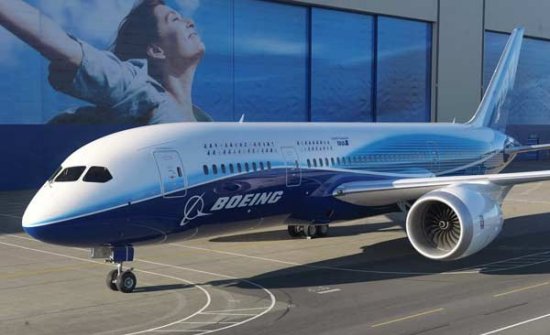
Boeing 787 Dreamliner Medium to Long-Range Jetliner |
|
DESCRIPTION:
The 787 Dreamliner program began as a response to the enormous Airbus A380. While Airbus was developing its first "super jumbo jet," Boeing chose to focus its resources on the more lucrative midsize market by developing a replacement for the 767 and A300. Boeing first explored a revolutionary design dubbed the Sonic Cruiser hoping to attract customers with increased speed, but studies of a more conventional concept continued as well. While not as radical looking as the Sonic Cruiser, this conventional design's promise to significantly cut operating costs through the use of advanced fuel efficient technologies proved very attractive to the airline market. Boeing has stated the 787 will be 15% to 20% more efficient and burn 17% less fuel than the 767 due to the innovative use of new technology. Perhaps the most challenging of these advances is the extensive use of lightweight composite materials that make up much of the wing and fuselage structures. While composites have been widely used in aviation since the 1980s, the 787 is the first commercial airliner to use the materials for the majority of its construction. The reduced weight of its structure coupled with aerodynamic improvements to reduce drag are said to account for about a third of the Dreamliner's fuel savings. Another third comes from improvements in engine technology while the remainder is due to advanced systems like its electrical architecture that doesn't require bleed air from the engines. The program was officially launched in 2004 under the name 7E7, the "E" representing efficient, when All Nippon Airways of Japan placed an order for 50 of the airliners. The name was later changed to the more conventional 787 in 2005, and the type has since attracted orders faster than any other airliner in Boeing's history. Unfortunately, its revolutionary technologies have come at the cost of significant development and production problems. The largest delays have resulted from Boeing's decision to make greater use of subcontractors in assembling the 787. Rather than building the entire aircraft at its factory near Seattle, Boeing chose to have complete subsystems built around the world and transported to Washington for final assembly. Major suppliers are located in Italy, Japan, Australia, Canada, as well as sites across the United States. Many of these subcontractors have had difficulties performing more complex subassembly tasks within Boeing's aggressive schedule. Part shortages, labor strikes, flight control software issues, and redesign efforts prompted by excess weight have also contributed to delays that have extended development by at least two years. Thanks to these problems, Boeing has been forced to pay compensation to many of its customers as well as offer steep discounts on replacement aircraft until the 787 is ready for service. First flight had been planned for mid-2007 but did not finally occur until December 2009. Boeing must also maintain a very brisk flight test program in hope of meeting the first delivery date, currently scheduled for late 2010. The first version to enter service will be the 787-8 base model. Boeing has also launched the lengthened 787-9 with higher passenger capacity and greater range. A high-density variant with reduced fuel capacity for shorter routes called the 787-3 is also under development, but this model will likely be delayed indefinitely due to weak demand. Boeing is planning a further stretched model called the 787-10 as well as a freighter version. Counting the three 787 variants currently in development, a record total of 851 firm orders had been placed by December 2009, even after 84 cancellations. Last modified 02 May 2011 |
|
| HISTORY: | |
| First Flight | (787-8) 15 December 2009 |
| Service Entry |
(787-8) planned for late 2010 (with All Nippon Airways) (787-9) planned for 2012 (with Air New Zealand) |
| CREW: | two flight crew: pilot, co-pilot |
| PASSENGERS: |
(787-3) 290 in two classes, 330 in one class (787-8) 210 in three classes, 250 in one class (787-9) 280 in three classes |
| COST: |
(787-3) $146 to $152 million [2007$] (787-8) $157 to $167 million [2007$] (787-9) $189 to $200 million [2007$] |
| DIMENSIONS: | |
| Length |
(787-3) 186.08 ft (56.72 m) (787-8) 186.08 ft (56.72 m) (787-9) 206.08 ft (62.81 m) |
| Wingspan |
(787-3) 169.67 ft (51.72 m) (787-8) 197.25 ft (60.12 m) (787-9) 208.00 ft (63.40 m) |
| Height |
(787-3) 55.50 ft (16.92 m) (787-8) 55.50 ft (16.92 m) (787-9) 55.67 ft (16.97 m) |
| Fuselage Diameter | 19.40 ft (5.91 m) |
| CABIN: | |
| Length |
(787-8) 138.75 ft (42.29 m) (787-9) 158.75 ft (48.39 m) |
| Width |
(787-3) 18.83 ft (5.74 m) (787-8) 18.83 ft (5.74 m) (787-8 VIP) 17.92 ft (5.46 m) (787-9) 18.83 ft (5.74 m) (787-9 VIP) 17.92 ft (5.46 m) |
| Height | 7.5 ft (2.29 m) |
| Main Passenger Door | unknown |
| CARGO CAPACITY: | |
| Baggage Volume | (787-8) 4,826.0 ft³ (136.7 m³) |
| Cargo Volume |
(787-3) 4,400.0 ft³ (124.6 m³) (787-8) 4,400.0 ft³ (124.6 m³) (787-8 VIP) 4,826.0 ft³ (136.7 m³) (787-9) 5,400.0 ft³ (152.9 m³) (787-9 VIP) 6,090.0 ft³ (172.4 m³) |
| Container Capacity |
(787-3) 28 LD3 or 9 standard pallets (787-8) 28 LD3 or 9 standard pallets (787-9) 36 LD3 or 11 standard pallets |
| Freight Doors | unknown |
| WING: | |
| Root Airfoil Section | unknown |
| Tip Airfoil Section | unknown |
| Area | unknown |
| Aspect Ratio | unknown |
| Sweepback Angle | 32.2° at quarter chord |
| Control Surface Areas |
outboard ailerons: unknown inboard ailerons: unknown outboard flaps: unknown inboard flaps: unknown spoilers: unknown |
| TAIL: | |
| Tailplane Span | 65.00 ft (19.81 m) |
| Tailplane Area | unknown |
| Tailfin Area | unknown |
| Control Surface Areas |
elevator: unknown rudder: unknown |
| UNDERCARRIAGE: | |
| Type | Retractable tricycle with two main gear and single steerable nose gear |
| Main Gear |
Four wheels per unit, tire size 50 x 20.0R22/34PR |
| Tire Pressure |
(787-3) 173 psi (1,193 kPa) (787-8) 221 psi (1,524 kPa) (787-9) 213 psi (1,468 kPa) |
| Nose Gear | Twin wheels per unit, tire size 40 x 16.0P16/26PR |
| Tire Pressure | 187 psi (1,289 kPa) |
| Steering Angle | 65° |
| Wheel Track | 32.17 ft (9.80 m) |
| Wheel Base |
(787-3) 74.75 ft (22.78 m) (787-8) 74.75 ft (22.78 m) (787-9) 84.75 ft (25.83 m) |
| WEIGHTS & LOADINGS: | |
| Empty |
(787-3) 223,100 lb (101,195 kg) (787-8) 242,000 lb (109,770 kg) (787-8 VIP) 261,100 lb (118,430 kg) (787-9) 254,300 lb (115,350 kg) (787-9 VIP) 281,800 lb (127,820 kg) |
| Normal Takeoff | unknown |
| Maximum Takeoff |
(787-3) 364,000 lb (165,105 kg) (787-8) 484,000 lb (219,540 kg) (787-9) 540,000 lb (244,940 kg) |
| Maximum Landing |
(787-3) 355,000 lb (161,025 kg) (787-8) 370,000 lb (167,825 kg) (787-9) 421,000 lb (190,950 kg) |
| Fuel Capacity |
(787-3) 75,820 lb (34,390 kg) in 11,085 gal (41,960 L) wing tanks (787-8) 229,330 lb (104,025 kg) in 33,530 gal (126,915 L) wing tanks (787-9) 250,980 lb (113,840 kg) in 36,695 gal (138,900 L) wing tanks |
| Maximum Payload | (787-8) 100,000 lb (45,360 kg) |
| Wing Loading | unknown |
| Thrust/Weight Ratio | unknown |
| PROPULSION: | |
| Powerplant |
General Electric GEnx or Rolls-Royce Trent 1000 |
| Engine Rating |
(787-3) 2 x 53,000 lb (235.8 kN) (787-8) 2 x 64,000 lb (284.7 kN) (787-9) 2 x 70,000 lb (311.3 kN) |
| Engine Intakes | Two nacelles on wing pylons |
| Fuel Type | Jet A, Jet A-1 |
| PERFORMANCE: | |
|
Max Level Speed (at altitude) |
585 mph (945 km/h) at 40,000 ft (12,190 m), Mach 0.89 |
|
Max Level Speed (at sea level) |
unknown |
| Cruise Speed | 560 mph (900 km/h) at 40,000 ft (12,190 m), Mach 0.85 |
| Takeoff Speed | unknown |
| Landing Speed | unknown |
| Takeoff Distance | unknown |
| Landing Distance | unknown |
| Maximum Climb Rate | unknown |
| Service Ceiling | 43,000 ft (13,105 m) |
| Range |
(787-3) 3,000 to 3,500 nmi (5,555 to 6,480 km) (787-8) 8,000 to 8,500 nmi (14,815 to 15,740 km) (787-8 VIP) 9,285 to 10,440 nmi (17,195 to 19,335 km) (787-9) 8,600 to 8,800 nmi (15,925 to 16,295 km) (787-9 VIP) 9,850 to 10,250 nmi (18,985 to 18,240 km) |
| g-Limits | unknown |
| SYSTEMS: | |
| Avionics | Honeywell crew information system/management system, Smiths Aerospace common core system comprising two common computing resources cabinets, ARINC 664 deterministic ethernet/advanced communications network, Thales integrated flight displays, Rockwell Collins communications and surveillance systems, dual head up displays |
| Flight Controls | Digital fly-by-wire |
| Electrical | Variable-frequency electrical system powered by Hamilton Sundstrand power generators and APU |
| Hydraulics | 5,000 psi (34,475 kPa) |
| Braking | Goodrich or Messier Bugatti electric brakes |
| COMPOSITION: |
|
| VARIANTS: | |
| 7E7 | Original designation for the 787 |
| 787-3 | Short-range, high-density model using the same fuselage as the 787-8 but with increased passenger capacity and decreased fuel load for shorter domestic routes, also replaces the raked wingtips of the 787-8 with winglets to reduce wingspan and fit into smaller gates; all orders cancelled or converted to other models so further development may be stopped |
| 787-8 | First production model designed to replace the 767-200ER and 767-300ER; 656 ordered by December 2009 |
| 787-8 VIP | Luxury model for the Boeing Business Jet division based on the 787-8 |
| 787-9 | Stretched model designed to replace the 767-400ER that carries more passengers than the 787-8 over longer distances by lengthening the fuselage, increasing the wingspan, and increasing fuel capacity; 195 ordered by December 2009 |
| 787-9 VIP | Luxury model for the Boeing Business Jet division based on the 787-9 |
| 787-10X | Proposed stretch model based on the 787-9 but with reduced range to carry 290 to 310 passengers and increase cargo capacity, would replace the 777-200ER and compete with the A350-900 |
| 787F | Proposed cargo freighter |
| OPERATORS: | |
|
Aeroflot Aeroméxico Air Astana Air Berlin Air Canada Air China Air Europa Air India Air New Zealand Air Niugini All Nippon Airways American Airlines Aviation Lease and Finance Company (ALAFCO) Arik Air Arkia Israel Airlines Avianca Aviation Capital Group AWAS Azerbaijan Airlines Biman Bangladesh Airlines Boeing Business Jet (BBJ) British Airways China Aviation Supplies Import and Export Group Corporation (CASGC) China Eastern Airlines China Southern Airlines CIT Aerospace Group Continental Airlines Dubai Aerospace Enterprise Ethiopian Airlines Etihad Airways Garuda Indonesia Grand China Airlines Gulf Air Hainan Airlines Hong Kong Airlines Icelandair International Lease Finance Corporation (ILFC) Iraqi Airways Japan Airlines Jet Airways Kenya Airways Korean Air LAN Chile Airlines LCAL LOT Polish Airlines Monarch Airlines Northwest Airlines PrivatAir (BBJ) Qantas Qatar Airways Royal Air Maroc Royal Jordanian Airlines Shanghai Airlines Singapore Airlines Thomson Airways Travel Service United Airlines Uzbekistan Airways Vietnam Airlines Vietnam Aircraft Leasing Company (VALC) Virgin Atlantic Airways |
|
|
3-VIEW DIAGRAM:

|
|
| SOURCES: | |
|
|
|


|
Aircraft | Design | Ask Us | Shop | Search |

|
|
| About Us | Contact Us | Copyright © 1997- | |||
|
|
|||