|
||||||||||
|
|
||||||||||
|
||||||||||
|
|
||||||||||
 - -
|
|
|
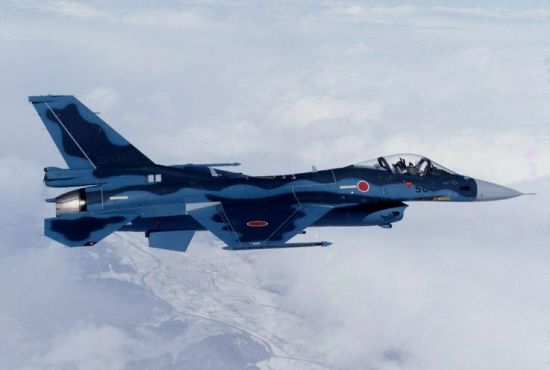
Mitsubishi F-2 Multi-Role Fighter |
|
DESCRIPTION:
The Japanese government issued the FS-X requirement to replace the F-1 attack fighter. The FS-X specified an advanced fighter bomber to be built indigenously by Japanese industry. Mitsubishi was named prime contractor in 1988 with Fuji and Kawasaki also contributing. The American firm General Dynamics (later purchased by Lockheed Martin) also assumed a 40% share of the project. This decision was made so that Mitsubishi could base its design on the American F-16C fighter. However, the US Congress raised many questions about technology transfer issues that not only delayed the program by at least two years but increased its overall cost by an estimated 70%. Nevertheless, this additional time did allow designers to significantly alter original plans and develop a much improved (albeit much more expensive) derivative of the F-16. The FS-X that emerged from this process, though superficially similar in appearance and performance, is much larger and heavier than the original F-16. Now designated as the F-2, the design features a larger wing, increased payload, enlarged vertical and horizontal tails, and more advanced radar and navigation systems. The F-2 also makes extensive use of composite materials in the airframe and radar absorbant materials to reduce observability. The F-2 successfully overcame its early difficulties and is now in service with the Air Self Defence Force. Japan had originally hoped to build as many as 141 F-2 fighters but increasing unit cost forced production to end at 98 aircraft, including 65 single-seat F-2A attack fightes and 33 two-seat F-2B trainers. More than half of the F-2B fleet was heavily damaged (probably beyond repair) when 18 trainers were submerged in the 2011 tsunami that struck the Matsushima air base in northern Japan.
Last modified 29 April 2011
|
|
| HISTORY: | |
| First Flight | 7 October 1995 |
|
Service Entry
|
2001
|
| CREW: |
one: pilot
|
|
ESTIMATED COST:
|
$108 million [2004$]
|
| AIRFOIL SECTIONS: | |
| Wing Root | unknown |
|
Wing Tip
|
unknown
|
| DIMENSIONS: | |
| Length | 50.92 ft (15.53 m) |
| Wingspan | 36.52 ft (11.13 m) |
| Height | 16.31 ft (4.97 m) |
| Wing Area | 375 ft² (34.84 m²) |
|
Canard Area
|
not applicable
|
| WEIGHTS: | |
| Empty |
[F-2A] 21,000 lb (9,525 kg) [F-2B] 21,235 lb (9,635 kg) |
| Normal Takeoff | unknown |
| Max Takeoff | 48,700 lb (22,100 kg) |
| Fuel Capacity |
internal: 8,470 lb (3,840 kg) [F-2A] internal: 6,830 lb (3,100 kg) [F-2B] external: 6,170 lb (2,800 kg) in one 300 gal (1,135 L) and two 600 gal (2,270 L) tanks |
|
Max Payload
|
19,840 lb (9,000 kg)
|
| PROPULSION: | |
| Powerplant | one General Electric F110-129 afterburning turbofan |
| Thrust |
17,000 lb (75.62 kN) 29,600 lb (131.67 kN) with afterburner |
| PERFORMANCE: | |
| Max Level Speed |
at altitude: Mach 2.0 at sea level: Mach 1.1 |
| Initial Climb Rate | unknown |
| Service Ceiling | 65,555 ft (20,000 m) |
| Range |
typical: 900 nm (1,665 km) ferry: unknown |
| g-Limits |
+9 / -3
|
| ARMAMENT: | |
| Gun | one 20-mm M61A1 cannon |
| Stations | seven hardpoints and two wingtip rails |
| Air-to-Air Missile | AIM-7 Sparrow, AIM-9 Sidewinder, AAM-1, AAM-3 |
| Air-to-Surface Missile | AGM-65 Maverick, ASM-2 |
| Bomb | Mk 82 GP, GCS-1, cluster |
| Other |
rocket pods
|
| KNOWN VARIANTS: | |
| FS-X | Original project designation |
| TFS-X | Original designation for a two-seat trainer variant |
| XF-2A | Prototype single-seat fighter; 2 built |
| XF-2B | Prototype two-seat trainer; 2 built |
| F-2A | Production single-seat fighter equipped primarily for air superiority and anti-shipping missions; 65 built |
| F-2B | Production two-seat trainer; 33 built |
| Advanced trainer |
Derivative of the F-2B proposed as a replacement for the T-2 trainer
|
|
KNOWN COMBAT RECORD:
|
none
|
|
KNOWN OPERATORS:
|
Japan, Nihon Koku-Jieitai (Japan Air Self Defence Force)
|
|
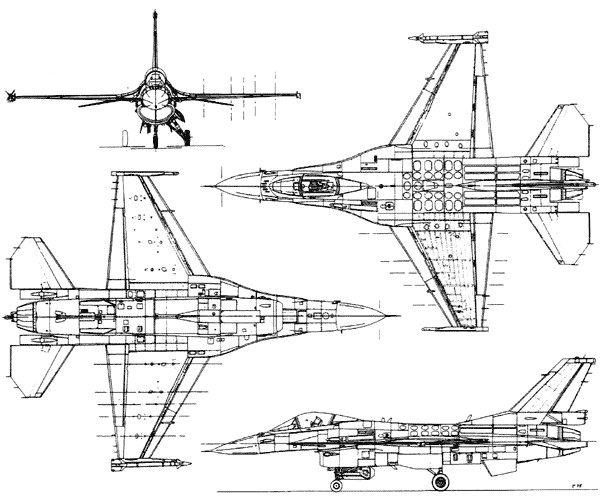
3-VIEW SCHEMATIC:
|
|
SOURCES:
|
|


|
Aircraft | Design | Ask Us | Shop | Search |

|
|
| About Us | Contact Us | Copyright © 1997- | |||
|
|
|||