|
||||||||||
|
|
||||||||||
|
||||||||||
|
|
||||||||||
 - -
|
|
|
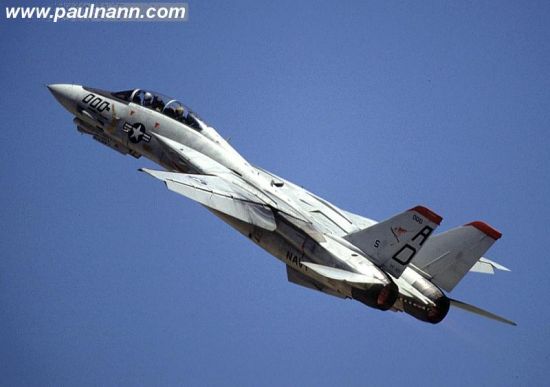
Grumman F-14 Tomcat Carrier-borne Multi-Role Fighter |
|
DESCRIPTION:
Following the cancellation of the F-111B, Grumman's proposal for a new long-range air superiority fighter was accepted by the US Navy. This aircraft was ultimately accepted as the F-14 Tomcat, and the new fighter incorporated a number of advanced features. Among these are variable-sweep wings that allow optimum efficiency throughout the plane's flight envelope. Minimum sweep is used during low-speed flight to reduce takeoff and landing speeds while maximum sweep reduces drag during supersonic flight. In combination with its large fuel capacity, varying the wing geometry allows the F-14 to maximize range and endurance in its primary air patrol and escort mission. The F-14 is also equipped with a sophisticated array of armament and avionics tailored to long-range air defense. Carrying the Phoenix missile and the advanced AWG-9 radar, the Tomcat is capable of engaging enemy aircraft and missiles from over 100 miles away. This capability is important since the F-14 is tasked with the mission of defending aircraft carrier battle groups from massed air attack. The Navy began taking delivery of the first production F-14A models in the early 1970s. However, these aircraft were hampered by inadequate Pratt & Whitney TF30 engines that limited the Tomcat's performance and reliability. Several aircraft were eventually upgraded to the F-14A+ standard (later known as the F-14B) that added much improved General Electric F110 engines. The final production model was the F-14D equipped with an improved APG-71 radar. After the fall of the Soviet Union, the F-14's air defense mission was considered obsolete, so many aircraft were further upgraded with a limited ground attack capability during the 1990s. Numerous additional upgrade programs were also proposed by Grumman in the hopes of keeping the F-14 in service beyond 2010. Most recent of these concepts were the Super Tomcat, Attack Super Tomcat, and ASF-14 which would add a far more thorough ground attack capability. Unfortunately, the existing F-14 fleet requires extensive maintenance and has become too expensive to keep in service. Phaseout of the F-14 had originally been scheduled for 2010 or 2012, but has been moved progressively forward as the F/A-18E/F Super Hornet has entered service. The final F-14A squadron was retired in 2004 and the last F-14B was removed from service in 2005. Only two squadrons of the F-14D remain operational and concluded the Tomcat's final combat tour in February 2006. The last F-14 squadron was disbanded and transitioned to the F-18F in May 2006.
Data below for F-14A and F-14D |
|
| HISTORY: | |
| First Flight |
(F-14A) 21 December 1970 (F-14D) 24 November 1987 |
| Service Entry | October 1972 |
|
Retirement
|
(F-14A) 8 September 2004 (F-14B) November 2005 (?) (F-14D) May 2006 |
| CREW: |
two: pilot, radar intercept officer
|
|
ESTIMATED COST:
|
$38 million [1998$]
|
| AIRFOIL SECTIONS: | |
| Wing Root | unknown |
|
Wing Tip
|
unknown
|
| DIMENSIONS: | |
| Length | 62.67 ft (19.10 m) |
| Wingspan |
unswept: 64.08 ft (19.54 m) swept: 38.17 ft (11.65 m) overswept: 33.29 ft (10.15 m) |
| Height | 16.00 ft (4.88 m) |
| Wing Area | 565 ft² (52.49 m²) |
|
Canard Area
|
not applicable
|
| WEIGHTS: | |
| Empty |
(F-14A) 40,105 lb (18,190 kg) (F-14D) 41,780 lb (18,951 kg) |
| Normal Takeoff |
(F-14A) 58,715 lb (26,630 kg) [fighter/escort] (F-14D) 64,095 lb (29,070 kg) [fighter/escort] (F-14D) 73,100 lb (35,155 kg) [fleet air defense] |
| Max Takeoff | 74,350 lb (33,725 kg) |
| Fuel Capacity |
internal: 2,385 gal (9,030 L) internal: 16,200 lb (7,350 kg) external: 535 gal (2,020 L) external: 3,800 lb (1,725 kg) |
|
Max Payload
|
14,500 lb (6,575 kg)
|
| PROPULSION: | |
| Powerplant |
(F-14A) two Pratt & Whitney TF30-412A/414A afterburning turbofans (F-14D) two General Electric F110-400 afterburning turbofans |
| Thrust |
(F-14A) 30,570 lb (136.00 kN) (F-14A) 41,800 lb (185.94 kN) with afterburner (F-14D) 33,220 lb (147.78 kN) (F-14D) 54,160 lb (240.93 kN) with afterburner |
| PERFORMANCE: | |
| Max Level Speed |
at altitude: 1,565 mph (2,515 km/h) at 36,000 ft (10,975 m), Mach 2.37 at sea level: 910 mph (1,470 km/h), Mach 1.2 |
| Initial Climb Rate | 30,000 ft (9,144 m) / min |
| Service Ceiling | 56,000 ft (17,070 m) |
| Range |
typical: 1,600 nm (2,965 km) ferry: 1,730 nm (3,200 km) |
| g-Limits |
unknown
|
| ARMAMENT: | |
| Gun | one 20-mm M61A1 Vulcan cannon (675 rds) |
| Stations | six external hardpoints |
| Air-to-Air Missile | AIM-7 Sparrow, AIM-9 Sidewinder, AIM-54 Phoenix |
| Air-to-Surface Missile | (F-14D) AGM-88 HARM, AGM-84 SLAM |
| Bomb | (F-14D) Rockeye, GBU-16, CBU-59 |
| Other |
ECM pods, TARPS pod (see below)
|
| KNOWN VARIANTS: | |
| F-14A | Original fighter model; 557 built |
| F-14/TARPS | F-14A models equipped to carry the Tactical Air Reconnaissance Pod System; about 50 converted |
| F-14B or F-14A+ | Original F-14B was to have improved Pratt & Whitney F401-400 engines but the design was cancelled due to rising costs after only one prototype had flown, the F-14A+ is an upgraded 'A' model with more powerful General Electric F110-400 engines, F-14A+ aircraft later re-designated F-14B; at least 32 converted |
| F-14C | Proposed upgraded F-14A with new engine, not built |
| F-14D | Much improved fighter with more powerful radar and improved missile capability, cancelled and resurrected several times but about 37 built and 18 converted from F-14A models (referred to as F-14D(R) model), later upgraded with limited ground attack capability under Quickstrike program |
| Super Tomcat | Proposed multi-role attack fighter |
| ASF-14 | Proposed alternative to the Navy version of the ATF (advanced tactical fighter) |
|
Attack Super Tomcat
|
Proposed attack model to replace the cancelled A-12 Avenger
|
|
KNOWN COMBAT RECORD:
|
Vietnam - Operation Frequent Wind (USN, 1975) Iran-Iraq War (Iran, 1980-1988) Gulf of Sidra - shot down 2 Libyan Su-22s (USN, 1981) Lebanon - US Multinational Force (USN, 1982-1983) Grenada - Operation Urgent Fury (USN, 1983) Libya - Operation El Dorado Canyon (USN, 1986) Mediterranean Sea - shot down 2 Libyan MiG-23s (USN, 1989) Iraq - Operation Desert Storm (USN, 1991) Iraq - Operation Southern Watch (USN, 1991-2003) Bosnia - Operation Deliberate Force (USN, 1995) Iraq - Operation Desert Strike (USN, 1996) Iraq - Operation Desert Fox (USN, 1998) Kosovo - Operation Allied Force (USN, 1999) Afghanistan - Operation Enduring Freedom (USN, 2001-present) Iraq - Operation Iraqi Freedom (USN, 2003-present) |
|
KNOWN OPERATORS:
|
Iran (Islamic Republic of Iran Air Force) United States (US Navy) |
|
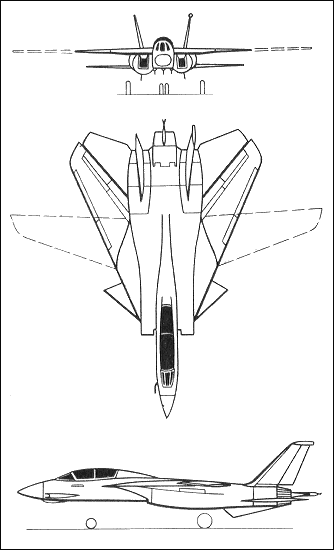
3-VIEW SCHEMATIC:
|
|
SOURCES:
|
|


|
Aircraft | Design | Ask Us | Shop | Search |

|
|
| About Us | Contact Us | Copyright © 1997- | |||
|
|
|||