|
||||||||||
|
|
||||||||||
|
||||||||||
|
|
||||||||||
 - -
|
|
|
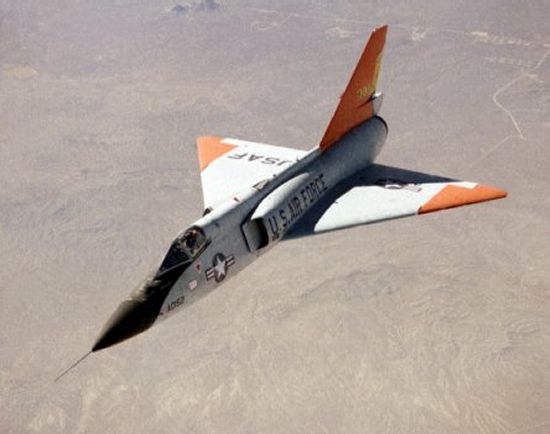
Convair F-106 Delta Dart Interceptor |
|
DESCRIPTION:
During the 1950s, the US Air Force wished to procure an advanced supersonic, all-weather "ultimate interceptor" to defend the US against Soviet bombers. Once it became apparent that this new aircraft would not be available by its 1954 deadline, the Air Force purchased the less capable Convair F-102A to fill the gap until the more sophisticated F-102B was ready. Luckily, this delay allowed great improvements to be made in aerodynamics, propulsion, and electronics making the "ultimate interceptor" that much more effective. Because so many changes were made both to the basic F-102 design and the Air Force requirements, the resulting interceptor was redesignated F-106. The new specifications called for the aircraft to intercept enemy bombers in all weather conditions at up to 70,000 ft and at speeds up to Mach 2. In addition, the aircraft was to be armed with guided missiles (still under development at the time) or rockets with atomic warheads. The F-106 was also to be equipped with an automatic guidance system that could be operated by ground controllers. The first prototypes suffered many performance problems, and difficulties with the advanced electronics were so severe that the project was almost cancelled. Luckily, modifications to the airframe and improvements in the electronics ultimately allowed the F-106 to meet all its design requirements. The F-106 remained in frontline service until the Aerospace Defense Command was disbanded in 1980, and the last of the 340 aircraft built were finally retired in 1988.
Last modified 27 September 2009
|
|
| HISTORY: | |
| First Flight |
(F-106A) 26 December 1956 (F-106B) 9 April 1958 |
| Service Entry |
June 1959
|
| CREW: |
one: pilot
|
| ESTIMATED COST: |
$4.7 to $4.9 million
|
| AIRFOIL SECTIONS: | |
| Wing Root | NACA 0004-65 mod |
| Wing Tip |
NACA 0004-65 mod
|
| DIMENSIONS: | |
| Length | 70.73 ft (21.56 m) |
| Wingspan | 38.29 ft (11.67 m) |
| Height | 20.27 ft (6.46 m) |
| Wing Area | 631.3 ft² (58.65 m²) |
|
Canard Area
|
not applicable
|
| WEIGHTS: | |
| Empty | 23,650 lb (10,730 kg) |
| Normal Takeoff | 34,510 lb (15,670 kg) |
| Max Takeoff | 41,830 lb (18,975 kg) |
| Fuel Capacity |
internal: unknown external: unknown |
|
Max Payload
|
unknown
|
| PROPULSION: | |
| Powerplant | one Pratt & Whitney J75-17 afterburning turbojet |
| Thrust |
17,200 lb (76.5 kN) 24,500 lb (109 kN) with afterburner |
| PERFORMANCE: | |
| Max Level Speed |
at altitude: 1,525 mph (2,455 km/h) at 40,000 ft
(12,190 m), Mach 2.31 at sea level: unknown |
| Initial Climb Rate | 29,000 ft (8,840 m) / min |
| Service Ceiling | 57,000 ft (17,375 m) |
| Range |
typical: 1,320 nm (2,440 km) ferry: 1,565 nm (2,900 km) |
| g-Limits |
unknown
|
| ARMAMENT: | |
| Gun | one 20-mm M61 Vulcan cannon (in place of Genie rocket) |
| Stations | one internal weapons bay and two (?) external hardpoints |
| Air-to-Air Missile | up to one AIR-2A Genie or AIR-2B Super Genie nuclear rocket and up to four AIM-4 Falcon |
| Air-to-Surface Missile | none |
| Bomb | none |
| Other |
none
|
| KNOWN VARIANTS: | |
| YF-106A | Prototype |
| F-106A | Production single-seat fighter-interceptor; 277 built |
| F-106B | Two-seat combat-capable trainer; 63 built |
| F-106C | Proposed improved variant, not built |
| F-106D | Proposed improved variant, not built |
| F-106X |
Proposed improved variant, not built
|
| KNOWN COMBAT RECORD: |
none
|
| KNOWN OPERATORS: |
United States (US Air Force) United States (NASA) |
|
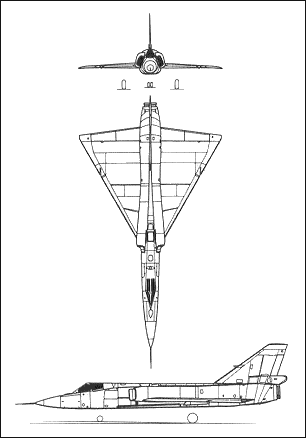
3-VIEW SCHEMATIC:
|
|
SOURCES:
|
|


|
Aircraft | Design | Ask Us | Shop | Search |

|
|
| About Us | Contact Us | Copyright © 1997- | |||
|
|
|||