|
||||||||||
|
|
||||||||||
|
||||||||||
|
|
||||||||||
 - -
|
|
|
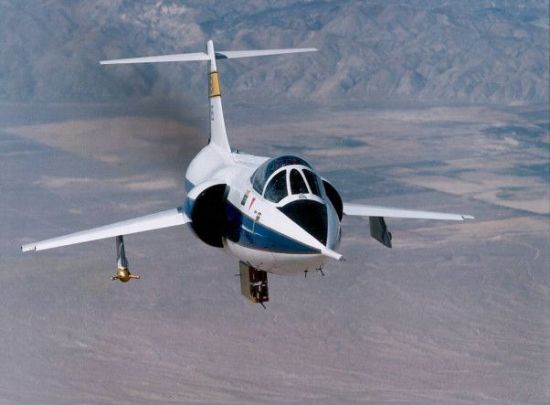
Lockheed F-104 Starfighter Multi-Role Fighter |
|
DESCRIPTION:
Experience in the Korean War showed that the US Air Force was in need of a new interceptor capable of high speeds and climb rates to engage Russian MiG-15s and bombers. The solution adopted by Lockheed was a small, lightweight design with a powerful engine called the F-104 Starfighter. Though capable of speeds exceeding Mach 2 and of reaching altitudes exceeding 90,000 ft, the Starfighter suffered from limited range, poor turn radius, limited payload capacity, and unforgiving flight characteristics. The F-104 was used for a time by both the Strategic Air Command as an interceptor and the Tactical Air Command as a fighter bomber. Due to its limitations, however, production was stopped in 1959 and the aircraft withdrawn from front-line service in 1960. Nevertheless, the Starfighter was given a new lease on life when West Germany accepted the updated F-104G as its primary fighter. Compared with the earlier USAF models, the F-104G featured much improved avionics and better low-level strike capabilities. The significantly more capable F-104G model soon attracted customers throughout Europe and Asia as well as Canada. Though only 296 examples had been built for the USAF, an additional 2,282 F-104 fighters were built for US allies. These exceptional aircraft served for many years but were finally withdrawn from service by the mid-1990s. The final variant to see service was the F-104S built under license by Alenia in Italy. Sold to both the Italian and Turkish air forces, the F-104S proved to be cost-effective, reliable, and popular among pilots. These aircraft were continually updated through the 1980s and 1990s under the ASA program, but Italy's F-104 fleet was finally retired and replaced by the F-16 in October 2004.
Data below for F-104G |
|
| HISTORY: | |
| First Flight | (XF-104) 7 February 1954 |
| Service Entry | January 1958 |
| Retirement |
(F-104S) 27 October 2004
|
| CREW: |
one: pilot
|
| ESTIMATED COST: |
unknown
|
| AIRFOIL SECTIONS: | |
| Wing Root | Biconvex 3.36% |
|
Wing Tip
|
Biconvex 3.36%
|
| DIMENSIONS: | |
| Length | 54.75 ft (16.69 m) |
| Wingspan | 21.92 ft (6.68 m) |
| Height | 13.50 ft (4.11 m) |
| Wing Area | 196.1 ft² (18.22 m²) |
|
Canard Area
|
not applicable
|
| WEIGHTS: | |
| Empty | 14,082 lb (6,387 kg) |
| Normal Takeoff | unknown |
| Max Takeoff | 28,779 lb (13,054 kg) |
| Fuel Capacity |
internal: 5,822 lb (2,641 kg) external: 5,538 lb (2,512 kg) |
|
Max Payload
|
4,310 lb (1,995 kg)
|
| PROPULSION: | |
| Powerplant | one General Electric J79-19 turbojet |
| Thrust |
10,000 lb (44.5 kN) 15,800 lb (70.28 kN) with afterburner |
| PERFORMANCE: | |
| Max Level Speed |
at altitude: 1,450 mph (2,335 km/h) at 36,000 ft (10,975 m), Mach 2.2 at sea level: Mach 1.2 |
| Initial Climb Rate | 50,000 ft (15,239 m) / min |
| Service Ceiling |
58,000 ft (17,680 m) 90,000 ft (27,430 m) zoom ceiling |
| Range |
typical: 260 nm (480 km) with max payload ferry: 1,576 nm (2,920 km) |
| g-Limits |
+7.33 (clean) or +5.5 (with wing tanks) / -2.8
|
| ARMAMENT: | |
| Gun | one 20-mm M61A1 Vulcan cannon (750 rds) |
| Stations | seven external hardpoints and two wingtip rails |
| Air-to-Air Missile | AIM-9 Sidewinder, AIM-7 Sparrow, Apside |
| Air-to-Surface Missile | AGM-65 Maverick, Kormoran, Penguin |
| Bomb | nuclear bombs, Mk 82/83 GP, cluster bombs |
| Other |
rocket pods, ECM pods
|
| KNOWN VARIANTS: | |
| XF-104 | Prototype |
| YF-104 | Pre-production aircraft used to test different engines; 17 built |
| F-104A | Production model for the USAF with blown flaps to reduce landing speeds; 153 built |
| NF-104A | F-104A airframes used for astronaut training; 3 converted |
| QF-104A | YF-104 and F-104A aircraft used as radio-controlled target drones |
| F-104B | Two-seat trainer based on the F-104A but with a new fuel system and armament layout; 26 built |
| F-104C | Upgraded one-seat tactical fighter bomber used by the USAF with a new engine and armed with Sidewinder missiles, bombs, or rocket pods; 77 built |
| F-104D | Two-seat trainer based on the F-104C model; 21 built |
| CF-104D | Canadian two-seat trainer built under license; 38 built |
| F-104DJ | Two-seat trainer for Japan; 20 built |
| F-104F | Improved attack fighter based on the F-104D model and sold to Germany; 30 built |
| F-104G | German multi-role fighter with ground attack capability, aerodynamic refinements, a stronger airframe, more advanced avionics, and a new engine; 1,127 built for European countries |
| TF-104G | German two-seat trainer; 220 built |
| RF-104G | German reconnaissance model with a camera pod in place of the Vulcan cannon; 189 built |
| RTF-104G | Two-seat trainer that could be equipped for reconnaissance duties |
| CF-104 | Canadian multi-role fighter based on the F-104G and built under license; 200 built |
| F-104J | Japanese multi-role fighter based on the F-104G and built under license; 210 built |
| F-104N | F-104G aircraft built for NASA as supersonic chase planes |
| F-104S | Multi-role fighter based on the F-104G and built by Aeritalia for Italy and Turkey, last operational version; 245 built |
| F-104S ASA | Italian F-104S models upgraded by Aeritalia/Alenia under the Aggiornamento Sistemi d'Arma program with new radar, avionics, and weapon systems; 150 converted |
| F-104S ASA M |
Final modernization program to keep the Italian F-104S ASA fleet in service into the 21st century by
replacing outdated power systems and navigation avionics to improve maintainability; approximately 100
converted
|
| KNOWN COMBAT RECORD: |
Vietnam War (USAF, 1965-1968) Bangladesh War (Pakistan, 1971) |
| KNOWN OPERATORS: |
Belgium, Belgishe Luchtmacht/Force Aérienne Belge (Belgian Air Force) Canada (Royal Canadian Air Force) Denmark, Kongelige Danske Flyvevåbnet (Royal Danish Air Force) Germany, Deutsche Luftwaffe (German Air Force) Germany, Deutsche Marineflieger (German Naval Air Arm) Greece, Elliniki Polimiki Aeroporia (Hellenic Air Force) Italy, Aeronautica Militare Italiana (Italian Air Force) Japan, Nihon Koku-Jieitai (Japan Air Self Defence Force) Netherlands, Koninklijke Luchmacht (Royal Netherlands Air Force) Norway, Kongelige Norske Luftforsvaret (Royal Norwegian Air Force) Pakistan, Pakistan Fiza'ya (Pakistani Air Force) Spain, Ejército del Aire Española (Spanish Air Force) Taiwan, Chung-Kuo Kung Chuan (Republic of China Air Force) Turkey, Türk Hava Kuvvetleri (Turkish Air Force) United States (US Air Force) United States (NASA) |
|
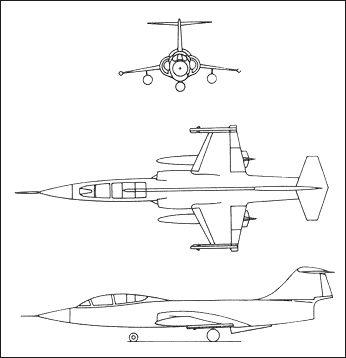
3-VIEW SCHEMATIC:
|
|
SOURCES:
|
|


|
Aircraft | Design | Ask Us | Shop | Search |

|
|
| About Us | Contact Us | Copyright © 1997- | |||
|
|
|||