|
||||||||||
|
|
||||||||||
|
||||||||||
|
|
||||||||||
 - -
|
|
|
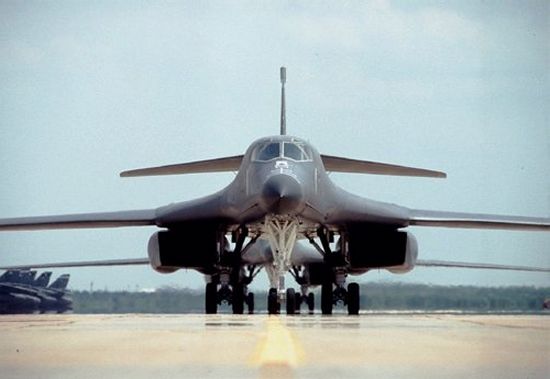
Rockwell B-1B Lancer Intercontinental Strategic Bomber |
|
DESCRIPTION:
Following cancellation of the B-70 Valkyrie program, the US Air Force began searching for a new design to replace the aging B-52. The result was the B-1 program that dates as far back as 1965. Four prototypes of the B-1A were built as high speed, high altitude bombers carrying a load of nuclear bombs. As the prototypes began flight testing, however, the program was cancelled by President Carter in 1977. The Reagan Administration later renewed the B-1 program in 1981 resulting in the significantly modified B-1B Lancer. The B-1B design includes variable-geometry wings and is designed to evade enemy radar by flying low altitude at near-sonic or supersonic speeds. The B-1 was one of the first aircraft designed with serious thought and effort put into its stealth characteristics. With its buried engines, curved body, and radar-absorbant materials, the B-1B has a radar cross-section less than 1/100th that of the B-52. The B-1B was originally built as a nuclear-armed replacement for the B-52. In this capacity, the plane's three bomb bays were compatible with SRAM and ALCM nuclear missiles as well as free-fall nuclear bombs. Under the terms of the Stategic Arms Reduction Treaty (START) between the US and Russia, however, the B-1B is no longer capable of delivering nuclear weapons. The Lancer has instead been re-equipped as a conventional bomber to operate alongside the B-52H Stratofortress. Compatibility with a wide array of conventional missiles and bombs has been developed under the Conventional Mission Upgrade Program. Early phases of this effort gave the B-1B the ability to carry a large payload of Mk 82 500-lb or Mk 84 1,000-lb unguided bombs, cluster munitions, and the GPS-guided GBU-31 JDAM. Later upgrades have further added compatibility with the latest generation of precision guided weapons such as the Wind-Corrected Munitions Dispenser (WCMD), Joint Standoff Weapon (JSOW), and Joint Air-to-Surface Standoff Missile (JASSM). A total of 100 examples of the B-1B were originally built, but about a third of the fleet was retired in 2003 as a cost-saving measure. By 2004, 67 aircraft were in service with the Air Force while those operated by the Air National Guard had been retired. The remaining fleet continues to receive upgrades to improve reliability including new avionics, radar enhancements, communications system updates to support data links, cockpit modifications, and integration of a targeting pod. The upgraded B-1B fleet will probably continue in service until around 2025.
Data below for B-1B |
|
| HISTORY: | |
| First Flight |
(B-1A) 23 December 1974 (B-1B) 18 October 1984 |
|
Service Entry
|
1 October 1986
|
|
CREW:
|
four: pilot, co-pilot, two electronic warfare/weapon systems officers
|
|
ESTIMATED COST:
|
$283 million [1998$]
|
| AIRFOIL SECTIONS: | |
| Wing Root | unknown |
| Wing Tip |
unknown
|
| DIMENSIONS: | |
| Length | 147.00 ft (44.81 m) |
| Wingspan |
unswept: 136.71 ft (41.67 m) swept: 78.21 ft (23.84 m) |
| Height | 34.83 ft (10.36 m) |
| Wing Area | 1,950 ft² (181.2 m²) |
|
Canard Area
|
unknown
|
| WEIGHTS: | |
| Empty | 192,000 lb (87,090 kg) |
| Normal Takeoff | unknown |
| Max Takeoff | 477,000 lb (216,365 kg) |
| Fuel Capacity |
internal: unknown external: unknown |
|
Max Payload
|
80,000 lb (36,290 kg)
|
| PROPULSION: | |
| Powerplant | four General Electric F101-102 afterburning turbofans |
|
Thrust
|
123,120 lb (547.7 kN) with afterburner
|
| PERFORMANCE: | |
| Max Level Speed |
at altitude: 1,000 mph (1,600 km/h) at 36,090 ft (11,000 m), Mach 1.5 at sea level: 750 mph (1,205 km/h), Mach 0.99 low-level mission: 600 mph (965 km/h) at 200 ft (61 m) |
| Initial Climb Rate | unknown |
| Service Ceiling | unknown |
| Range | 6,090 nm (11,265 km) |
| g-Limits |
unknown
|
| ARMAMENT: | |
| Gun | none |
| Stations | three internal weapons bays and fourteen external hardpoints |
| Air-to-Surface Missile |
originally up to 38 AGM-69 SRAM or 22 AGM-86 ALCM [no longer permitted under START] up to 12 AGM-154 JSOW, up to 24 AGM-158 JASSM |
| Bomb |
originally up to 26 B28/B43 or 24 B61/B83 nuclear bombs [no longer permitted under START], up to 84 Mk 82 GP, up to 24 Mk 84 GP, up to 24 GBU-31 JDAM, up to 30 CBU-87/89/97 cluster, up to 30 CBU-103/104/105 WCMD |
| Other |
up to 84 Mk 36 or Mk 62 500-lb sea mines, up to 8 Mk 85 sea mines
|
| KNOWN VARIANTS: | |
| B-1A | Original bomber design with less-refined aerodynamics but capable of Mach 2 at altitude, was cancelled in 1977 in favor of rearming the B-52 with cruise missiles; 4 prototypes built |
| B-1B | Production model with an improved shape for greater stealth and better flight performance at low altitudes while sacrificing the higher speeds of the B-1A; 100 built |
| B-1B CMUP | Conventional Mission Upgrade Program to modernize the B-1B fleet and consisting of several Block upgrades |
| Block A | CMUP upgrade that added the ability to carry Mk 82 and Mk 84 bombs |
| Block B | CMUP upgrade completed in 1995 that added synthetic aperture radar improvements and better self-defense countermeasures |
| Block C | Enhanced Capability portion of the CMUP effort completed in 1997 that added the ability to carry up to 30 cluster bombs |
| Block D | Near Precision Capability portion of the CMUP effort that added improved targeting systems, secure communication gear, compatibility with JDAM bombs, and better electronic countermeasures including the ALE-50 towed decoy |
| Block E | CMUP upgrade completed in 2006 that added compatibility with the WCMD, JSOW, and JASSM weapons plus modernization of avionics |
| Block F | Defensive Systems Upgrade Program intended to improve electronic countermeasures and jamming capabilities but cancelled in 2002 due to high cost |
| EB-1B | Proposal to modify B-1B airframes as stand-off electronic warfare jamming platforms to replace the EA-6B Prowler jamming aircraft |
| B-1R |
Boeing proposal to rebuild the existing B-1B fleet as a "regional" fighter bomber force by replacing the
F101 engines with the F119 turbofan used in the F-22 to increase speed to
Mach 2.2 but at the cost of reduced range, the rebuilt bomber would carry an AESA radar for improved
targeting and would serve as a "truck" carrying a large payload of bombs, air-to-ground missiles, and
air-to-air missiles
|
| KNOWN COMBAT RECORD: |
Iraq - Operation Southern Watch (USAF, 1998-2003) Iraq - Operation Desert Fox (USAF, 1998) Kosovo - Operation Allied Force (USAF, 1999) Afghanistan - Operation Enduring Freedom (USAF, 2001-present) Iraq - Operation Iraqi Freedom (USAF, 2003-present) Libya - Operation Odyssey Dawn (USAF, 2011) |
| KNOWN OPERATORS: |
United States (US Air Force) United States (US Air National Guard) |
|
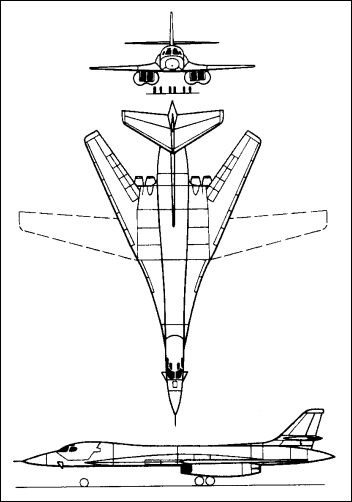
3-VIEW SCHEMATIC:
|
|
SOURCES:
|
|


|
Aircraft | Design | Ask Us | Shop | Search |

|
|
| About Us | Contact Us | Copyright © 1997- | |||
|
|
|||