|
||||||||||
|
|
||||||||||
|
||||||||||
|
|
||||||||||
 - -
|
|
|
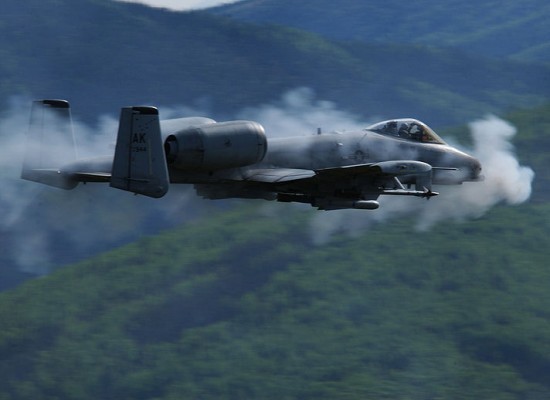
Fairchild Republic A-10 Thunderbolt II Ground-Attack Plane |
|
DESCRIPTION:
The A-10 resulted from a US Air Force requirement for a rugged attack plane to provide close-in support of ground troops using guided munitions. Carrying one of the most powerful guns ever placed on an aircraft, the 30-mm cannon fires "milk-bottle-size rounds" at rates of 2,100 or 4,200 shots per minute. The Warthog, as the A-10 is frequently called, is also fitted with a high aspect ratio wing well suited to low speed flight that provides hardpoints for a variety of bombs and missiles used for the close air support mission. Though able to operate guided missiles and bombs using a laser-designator pod under the nose, the avionics have remained simple for greater dependability and maintainability. The A-10 is also designed for survivability given its role flying low and slow over the battlefield. The A-10 is extremely rugged and able to continue flying even with an engine, a tail fin, or even part of a wing shot off the plane. The A-10 also provides further protection against groundfire by encasing the cockpit and the ammunition drum for the cannon within a titanium "tub." Several A-10 aircraft have also been adapted as OA-10 forward air control (FAC) platforms. Typically armed with rocket pods to mark targets and Sidewinder missiles for self-defense, the primary mission of the OA-10 is to locate targets and direct other aircraft in attacking them. The OA-10 is otherwise unchanged from the basic A-10, and both aircraft received few updates after production ceased in the 1980s until about 2005. Even early in its career, Air Force planners had questioned the usefulness of the A-10 in combat and doubted its ability to survive against modern air defenses. Plans had called for the A-10 fleet to be gradually retired and replaced by the F-16 during the 1990s. However, the A-10 soon proved its worth during Operation Desert Storm in 1991 when the Warthog was credited with destroying over 1,000 Iraqi tanks, 1,200 artillery pieces, and 2,000 other vehicles. Two A-10 pilots also shot down Iraqi helicopters over Kuwait during the conflict. Despite this success, the A-10 and OA-10 fleet was again in jeopardy of being retired during the late 1990s until its subsequent service in Afghanistan and Iraq again gave the attack plane a new lease on life. Many of the surviving aircraft are being upgraded to the A-10C standard under the Precision Engagement program. This upgrade includes updating the software and cockpit displays of older A-10 aircraft so they can carry the latest generation of guided weapons. Over 700 examples of the A-10 were originally built for the US Air Force. Many have since been transferred to the Air National Guard and Air Force Reserves or retired from service. Approximately 350 remained in use by 2004. As the A-10 fleet has been reduced, many of the retired planes have been offered for sale to foreign nations.
Data below for A-10A |
|
| HISTORY: | |
| First Flight |
(YA-10) 10 May 1972 (A-10A) 21 October 1975 |
|
Service Entry
|
March 1977
|
|
CREW:
|
one: pilot
|
|
ESTIMATED COST:
|
$9.8 million [1998$]
|
| AIRFOIL SECTIONS: | |
| Wing Root | NACA 6716 |
| Wing Tip |
NACA 6713
|
| DIMENSIONS: | |
| Length | 53.33 ft (16.26 m) |
| Wingspan | 57.50 ft (17.53 m) |
| Height | 14.67 ft (4.47 m) |
| Wing Area | 506 ft² (47.02 m²) |
| Canard Area |
not applicable
|
| WEIGHTS: | |
| Empty | 28,000 lb (12,700 kg) |
| Normal Takeoff | 32,730 lb (14,845 kg) [operating from forward airstrip] |
| Max Takeoff | 52,000 lb (23,585 kg) |
| Fuel Capacity |
internal: 10,700 lb (4,855 kg) external: up to 12,060 lb (5,470 kg) in three 600 gal (2,270 L) tanks |
|
Max Payload
|
16,000 lb (7,260 kg)
|
| PROPULSION: | |
| Powerplant | two General Electric TF34-100 turbofans |
|
Thrust
|
18,130 lb (80.64 kN)
|
| PERFORMANCE: | |
| Max Level Speed |
at altitude: unknown at sea level: 440 mph (705 km/h) [clean] sea level cruise: 345 mph (555 km/h) |
| Initial Climb Rate | 6,000 ft (1,830 m) / min |
| Service Ceiling | unknown |
| Range |
typical: 1,080 nm (2,000 km) ferry: 2,130 nm (3,950 km) |
| g-Limits |
unknown
|
| ARMAMENT: | |
| Gun | one 30-mm GAU-8/A seven-barrel cannon (1,350 rds) |
| Stations | 11 external hardpoints |
| Air-to-Air Missile | AIM-9L Sidewinder |
| Air-to-Surface Missile | up to 10 AGM-65B/D/G Maverick |
| Bomb |
(A-10A) GBU-10/12 Paveway laser-guided, GBU-15, up to 28 Mk 82 GP, Mk 83 GP, up to 16 Mk 84 GP, M117 GP,
Mk 20 Rockeye, BLU-52, BLU-107 Durandal, up to 16 CBU-52/71 cluster, up to 8 CBU-87 cluster, BL755
cluster (A-10C) GBU-? JDAM, CBU-105 WCMD |
| Other |
(A-10) ECM pods, navigation pods, jammer pods, chaff dispenser pods, up to 2 SUU-23/25/30/65 dispenser
pods, targeting pods (OA-10) LAU-68 rocket pod |
| KNOWN VARIANTS: | |
| YA-10 | Prototype that competed with the Northrop YA-9 for the Air Force A-X attack plane contract and won on 18 January 1973 |
| A-10A | Production attack plane; 721 built, about 90 upgraded with a radar altimeter, GPWS, autopilot, a new bomb sight, and the capability to use the 30-mm cannon against air units |
| OA-10A | A-10A airframes converted to the observation and forward air control (FAC) role |
| A-10T or A-10B | Proposed two-seat combat-capable trainer with an enlarged nose and taller tail fins that would have been modified from existing A-10A models; 30 were to be converted but the variant was cancelled |
| A-10NAW or YA-10B | Two-seat Night Adverse Weather demonstrator developed by Fairchild from an A-10 prototype for consideration by the USAF, included a second seat for a weapons officer responsible for ECM, navigation, and target acquisition; did not enter production but many of its features were later incorporated into the A-10 fleet |
|
A-10C
|
Precision Engagement upgrade for A-10A aircraft equipped with with new software and cockpit displays to
provide compatibility with precision guided weapons such as JDAM and WCMD
|
| KNOWN COMBAT RECORD: |
Iraq - Operation Desert Storm (USAF, 1991) Bosnia - Operation Deliberate Force (USAF, 1995) Kosovo - Operation Allied Force (USAF, 1999) Afghanistan - Operation Enduring Freedom (USAF, 2001-present) Iraq - Operation Iraqi Freedom (USAF, 2003-present) Libya - Operation Odyssey Dawn (USAF, 2011) |
| KNOWN OPERATORS: |
United States (US Air Force) United States (US Air Force Reserves) United States (US Air National Guard) |
|
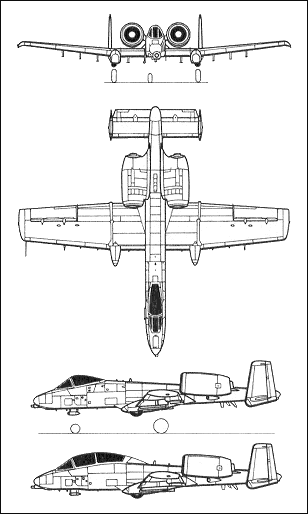
3-VIEW SCHEMATIC:
|
|
SOURCES:
|
|


|
Aircraft | Design | Ask Us | Shop | Search |

|
|
| About Us | Contact Us | Copyright © 1997- | |||
|
|
|||